Don’t go!
Please get in touch, and our engineers will draw up a bespoke solution for your project.

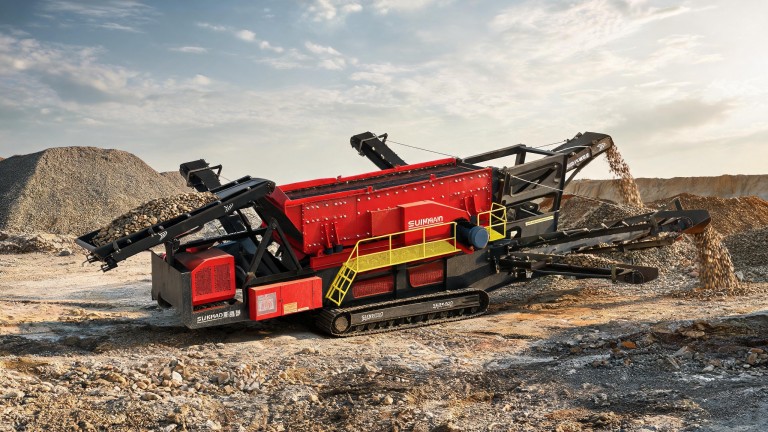
As the moisture content of the bulk material increases, the frequency of screen blockages in a mobile screen rises, whilst screening efficiency falls. The rate at which the screens become blocked is also influenced by the type of raw material and the mesh size.

Without a separate mobile screening plant, it is possible to produce four commercial fractions using existing crushing and screening units, following two proven processes that have been tested at industrial sites, with a particle size deviation of up to 7%.

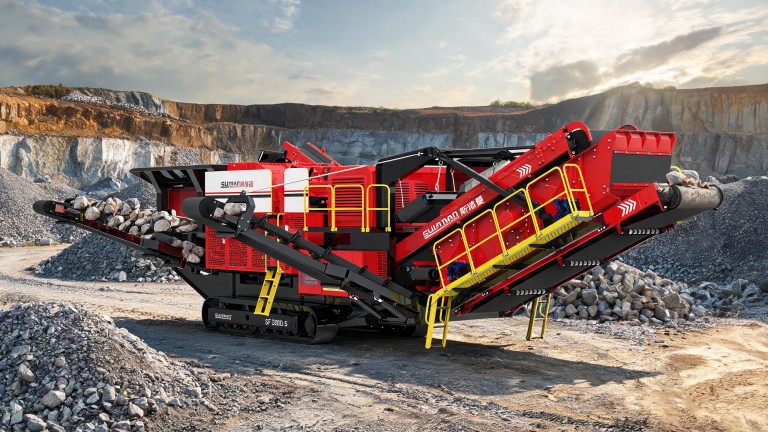
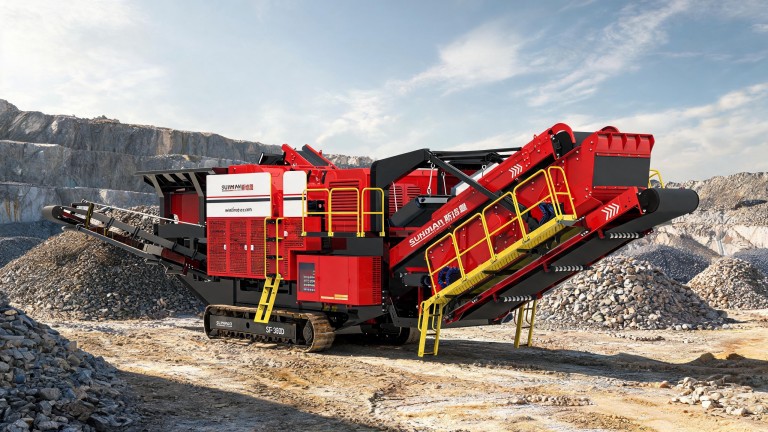
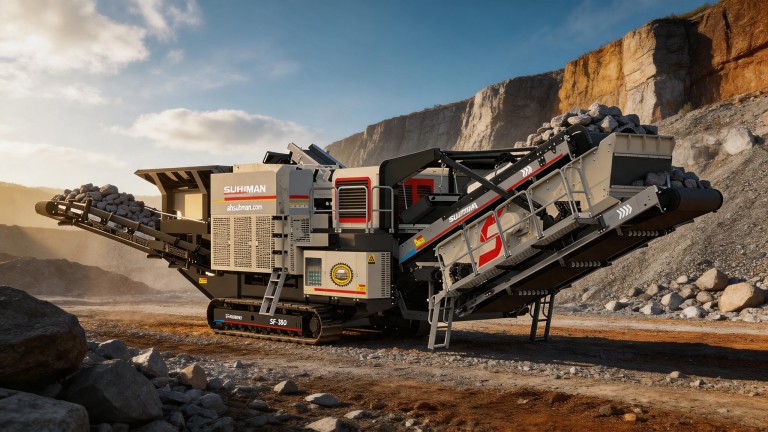
The actual throughput of a mobile crusher’s built-in screen is 20–150 t/h, depending on the crusher class, the type of feed material, the mesh size and the moisture content; exceeding the rated capacity accelerates wear and tear, and its performance is 15–20% worse than that of a separate screen.

In closed-circuit operation of secondary crushers, the material return rate is typically 30–40%; this varies depending on the type of crusher and the settings, and any deviation from the norm increases energy consumption and affects productivity.

Installing a double-deck screen reduces throughput by 7–12%, with a temporary additional drop of 3–4% during the first 72 hours. Adjusting the vibration compensates for up to 60% of the drop in output; however, it is not possible to completely eliminate the reduction.

It is permitted to load the mobile crusher using an excavator with a 2.5 m³ bucket: its specifications meet the manufacturers’ requirements; the only condition is that the unloading distance must be at least 300 mm.

For a 300 t/h mobile crusher, the optimum loader bucket capacity is 3.2–3.8 m³, adjusted according to the density of the raw material, the size of the hopper and the site area; and there are specific adjustments for different types of loaders.

The permissible weight of stones when feeding them into crushers depends on the type of crusher, the characteristics of the stone and the operating conditions; exceeding the limit reduces the service life of the equipment.

Regularly feeding pieces of raw material into the crusher that are larger than the recommended size increases the load, vibration and the proportion of coarse particles in the finished product, whilst reducing the service life of components and the time between servicing. Exceeding the limit by up to 10% does not have any significant consequences.

It is possible to process asphalt in hot conditions (25–45 °C) without it sticking in the crusher by: use an anti-adhesive coating, maintain a feed rate of ≥120 t/h, and ensure the chamber wall temperature does not exceed 55 °C.