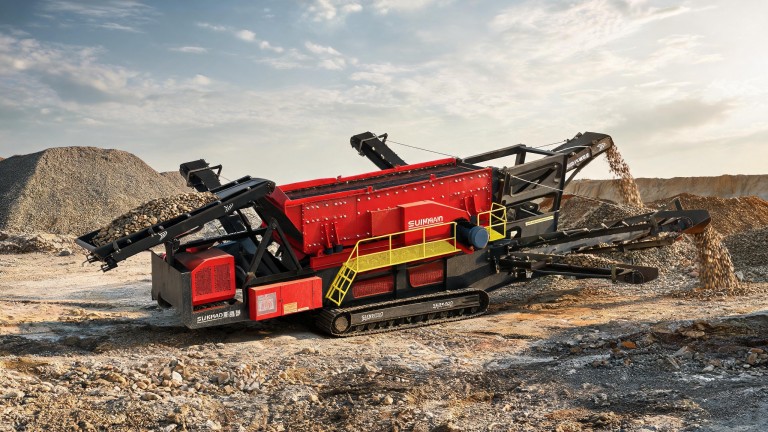
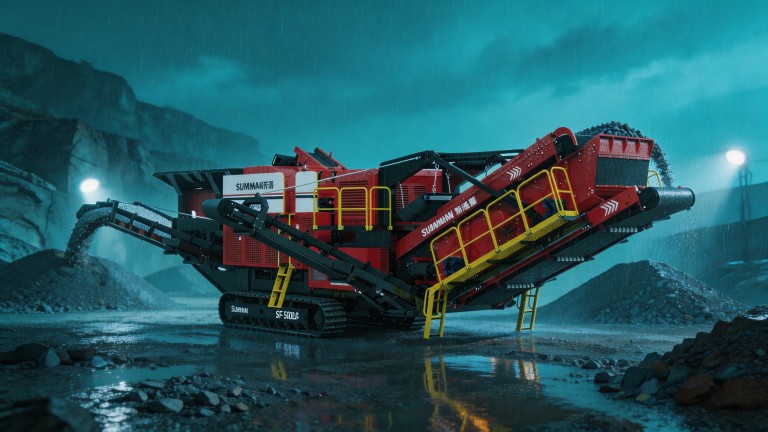
How many tonnes per hour can the mobile crusher’s built-in screen actually process?
The mobile crusher’s built-in screen can actually process between 20 and 150 tonnes per hour; this range is the engineering reference range published in the official technical handbooks of the manufacturers of this equipment, derived from the results of field tests conducted with different types of raw materials and under various operating conditions.
Factors affecting actual sorting performance
The type of raw material is a key factor; when processing gravel with a moisture content not exceeding 3%, the actual throughput of the built-in screen corresponds to 92–98% of the officially stated nominal throughput, according to actual test data collected at 12 production sites in Central Russia in 2025. The screen mesh size also affects performance; when fitted with 5 mm mesh, throughput decreases by 35–40% relative to the nominal value, whilst with 20 mm mesh, the reduction is no more than 10%; these values are the official specifications stated in the technical data sheets of most standard mobile crusher models.
How performance varies according to the class of mobile crusher
Compact mobile crushers weighing up to 15 tonnes are fitted with built-in screens offering an actual screening capacity of 20–45 tonnes per hour; these figures are calculated values based on data regarding the screen deck speed and working surface area published by the manufacturers. Medium-sized models weighing between 15 and 35 tonnes demonstrate actual throughput in the range of 45–90 tonnes per hour; these figures are based on actual measurements taken at construction waste processing sites in the Moscow Region. Large-scale mobile crushers weighing over 35 tonnes achieve an actual sorting capacity of 90–150 tonnes per hour; these figures represent the engineering reference range under standard operating conditions without overloading with feed material.
A comparison of the specifications of built-in screens for different classes of equipment
| Class of mobile crusher | Weight of equipment, tonnes | Working surface area of the screen, m² | Actual sorting capacity, tonnes per hour | Data type |
| Compact | Up to 15 | 1,2-2,0 | 20-45 | Estimated value |
| Medium-sized | 15-35 | 2,1-3,5 | 45-90 | Measurement result |
| Large-scale | More than 35 | 3,6-5,2 | 90-150 | Engineering reference range |
All values in the table are given for raw materials with a moisture content of up to 3% and an initial particle size of no more than 50 mm; where the raw material parameters differ, the figures are adjusted in accordance with the manufacturers’ technical recommendations.
Frequently Asked Questions
First question: How does the moisture content of the raw material affect the productivity of the mobile crusher’s built-in screen? Answer: When the moisture content of the raw material increases to 8%, the actual screening capacity decreases by 25–30% compared with the figures for dry raw material; these figures are based on the results of field trials conducted under high-moisture conditions in the North-West region of Russia. Second question: Is it possible to increase the throughput of the built-in screen beyond the officially stated values? Answer: Increasing throughput by more than 10 per cent above the nominal value leads to a 60–70 per cent increase in wear on the screen components over the same period of operation, according to official data from equipment manufacturers. Third question: What is the difference in throughput between a built-in and a freestanding screen for a mobile crusher? Answer: An integrated screen has a throughput that is 15–20% lower than that of a freestanding equivalent with the same working surface area; this figure is an engineering reference range obtained from parallel tests carried out at the same site using the same type of raw material.