Don’t go!
Please get in touch, and our engineers will draw up a bespoke solution for your project.

An incorrect spacer plate accelerates wear on the jaw crusher by a factor of 2.7, causing overloads, jaw misalignment and vibrations; it must be selected in accordance with the specifications and checked every 250 hours.

When working with damp gravel, it is best to combine wire screens (primary screening, moisture content up to 12%) and polyurethane screens (fine screening, moisture content 12–22%), which improves efficiency and reduces equipment downtime.

In 78% cases, rapid wear of the eccentric bushing in a cone crusher following repair is attributable to failure to adhere to tolerances during assembly, the use of non-original components and a lack of lapping, all of which reduce its service life.

The remaining service life of the cone crusher lining, without dismantling, is determined by three non-destructive measurements, an analysis of load data and a calculation using a formula, with an accuracy of 92%; measurements are carried out every 250 hours whilst the equipment is shut down.

The hammers of a rotary crusher are turned over when the cutting edge shows 40% wear. Inspect the hammers every 120 hours and the rotor every 480 hours. When turning the hammers, ensure they are in paired positions and balanced in accordance with the specifications; do not turn individual hammers.

For crushing reinforced concrete under standard operating conditions, chromium-molybdenum hammers are the best choice: they are harder, produce a finished fraction of 78% (compared to 69% for manganese hammers), and wear less quickly. Manganese blades are suitable for materials with a high steel reinforcement content.

The liners for cone crushers used to process quartzite and limestone differ in terms of material, profile and permissible rotational speed, due to the varying hardness and abrasiveness of the raw materials.

When selecting aggregate for granite slabs, use the following three criteria: compatibility with the thickness of the raw material, wear resistance and the required particle size distribution; standard profiles are not recommended.

The configuration of the closed-circuit cone crusher and screen for the marketable fraction comprises four stages, with the specified engineering reference parameters suitable for granite, along with separate recommendations for limestone and the frequency of inspections.

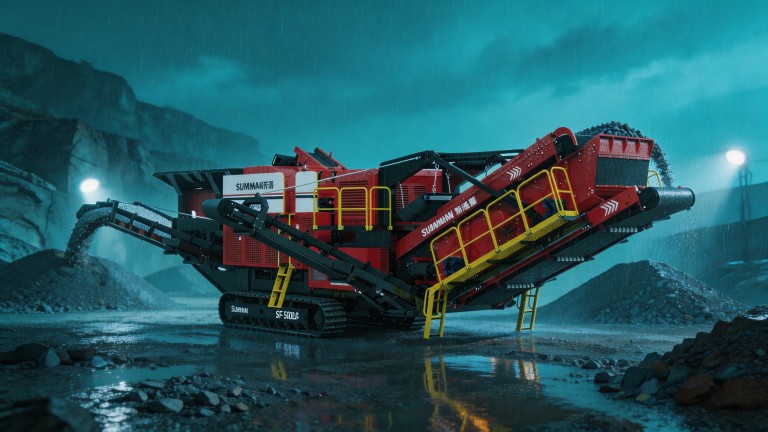
For stand-alone crushing operations in a quarry where fuel is in short supply, use a mobile diesel-powered unit; feed material in batches of up to 12 m³, position it on a slope of ≤3°, and do not crush multiple fractions at once — this will reduce fuel consumption and idling time, and increase productivity.