Don’t go!
Please get in touch, and our engineers will draw up a bespoke solution for your project.

The wedge-shaped wear of the crusher jaw plates is 62%; their wear depends on the hardness of the raw material and the design of the crusher; the materials for the plates are selected and the parameters are adjusted to minimise wear.

When the gap width remains constant, the output of a jaw crusher decreases due to wear on the jaw plates, changes in the particle size distribution of the raw material and disruptions to the feed rate; the reduction in output can reach 19–24%.

A cone crusher can be used to crush a wet gravel-sand mixture with a moisture content of up to 12%, with the feed size not exceeding 85% of the receiver, whilst reducing the feed rate by 15–20%; for clay content up to 5%, cleaning is required every 8 hours.

For soft limestone with a high fines content, a rotary crusher is more effective than a jaw crusher: it produces a higher yield of the final product, results in less over-grinding and lower load, does not require pre-removal of fines, and produces cubic particles.

Where flakiness is limited, a vertical rotary crusher is the optimal choice for railway ballast: it produces 12–18% of flake-shaped particles and requires 18–28 m². Increasing the rotor speed by 15% reduces this figure by 4–6 percentage points.

A cone crusher with the following specifications is suitable for crushing hard river pebbles: cone angle 19–23°, eccentric shaft stroke 20–40 mm, shaft speed 220–350 rpm, reinforced construction, and hydraulic protection against foreign objects.

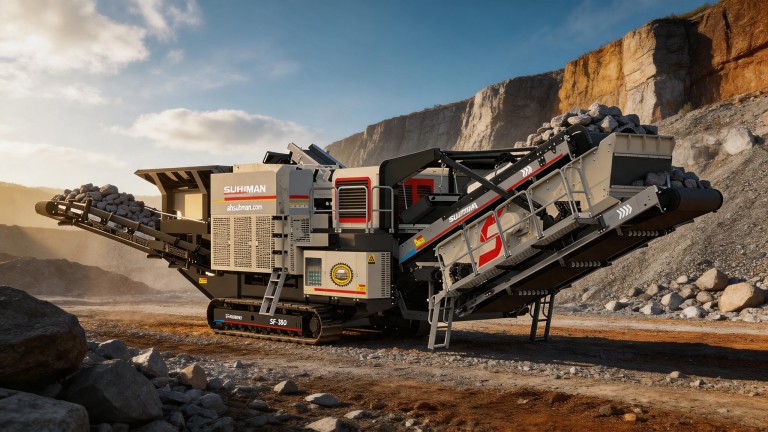
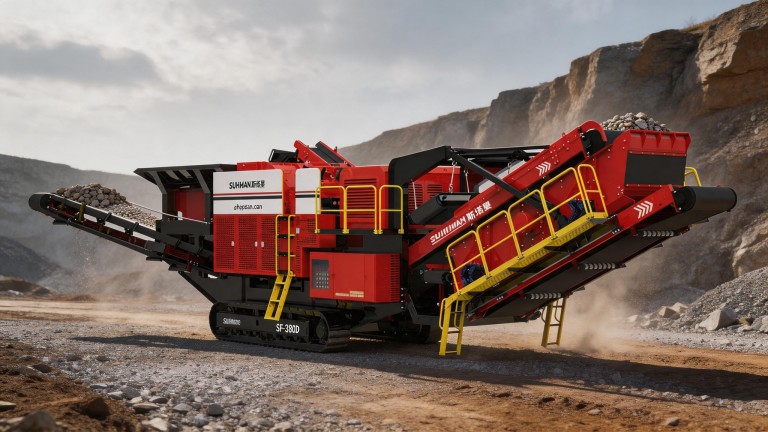
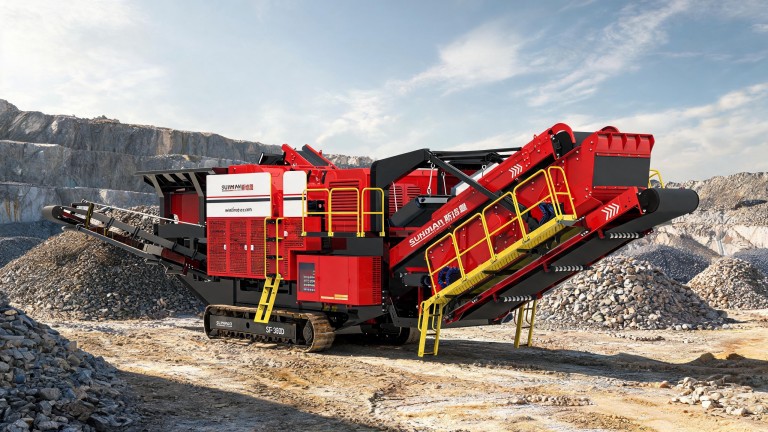
For narrow quarry benches (8–12 m), choose a mobile jaw crusher: chassis width ≤3 m, turning circle ≤9 m, hopper angle ≥42°, weight ≤45 tonnes; do not opt for standard models.

According to tests carried out during the processing of granite mixed with damp clay, the cone crusher performs more consistently than the rotary crusher: it operates for longer without requiring cleaning, produces a more precise particle size distribution, and experiences less wear on its components.

To select a jaw crusher for high-quartz basalt: crushing force from 350 MPa, jaw hardness from 550 HB, gap from 10 mm, a 15% drive unit more powerful than the standard version, optimum jaw angle of 18–22°, and additional housing protection is required.

The yield of the 5–20 mm fraction per pass depends on the raw material (granite 68–72%, etc.), the crusher (rotary crusher 81–85%, jaw crusher 41–45%) and the gap width, with a measurement error of 1.2–2.7%.