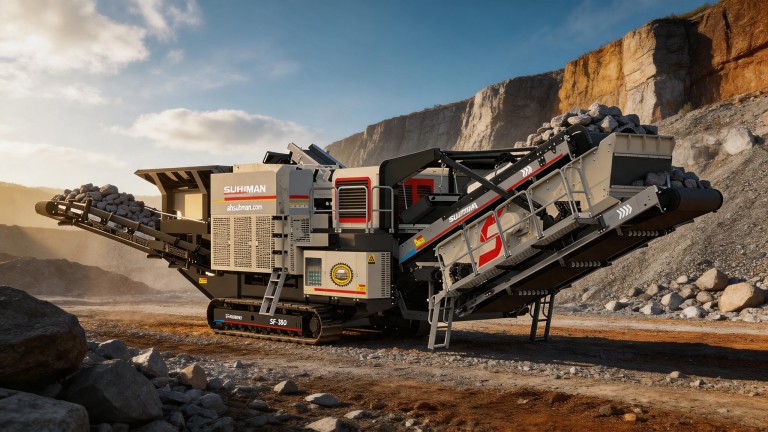
Clogging of the screens on a mobile screen is a common fault that brings the equipment to a standstill and reduces productivity. Listed below are seven key causes of this problem, which can be easily rectified if detected in good time.
High moisture content of the raw materials being processed
Moist material sticks to the sieve meshes, gradually clogging them completely; this is particularly evident when working with sand, coal and ore with moisture content levels exceeding the permissible limits. Simply drying the raw material sufficiently will resolve the problem.
Incorrect choice of sieve mesh size
If the mesh size is too close to the dimensions of the main fraction of the material being processed, the particles become firmly lodged in the mesh and do not fall into any of the fractions; therefore, sieves must be selected with a margin of size relative to the required fraction.
Abrasion and deformation of the sieve surface
Over time, due to constant vibration and friction between particles, the metal surface of the screen becomes deformed; the mesh openings change shape and become prone to material build-up. Regular inspection of the surface allows worn screens to be replaced before blockages occur.
Excessive feed rate into the screen
If the operator feeds more material into the equipment than it is capable of processing per unit of time, the layer of raw material on the screen becomes too thick; the particles do not have time to pass through the mesh and gradually accumulate, clogging the working surface. It is sufficient to adjust the feed rate.
Incorrect vibration amplitude setting
If the vibration amplitude is too small, the particles cannot bounce off the screen surface; they remain in contact with the mesh and become trapped in it, whilst an amplitude that is too large leads to rapid wear of the components, so the settings must be adjusted strictly in accordance with the equipment manual.
The presence of fibrous and sticky impurities in the raw material
Wood fibres, clay inclusions and other sticky impurities cling to the edges of the sieve mesh, forming a continuous film that gradually blocks all the working openings; to combat this, a pre-filter should be installed to remove such inclusions from the raw material.
Failure to clean the sieve regularly
Even when the equipment is operating correctly, fine particles gradually accumulate on the surface of the screen, eventually clogging the mesh; weekly mechanical cleaning of the surface using special brushes makes it possible to completely eliminate this cause of blockage without wasting time or resources.