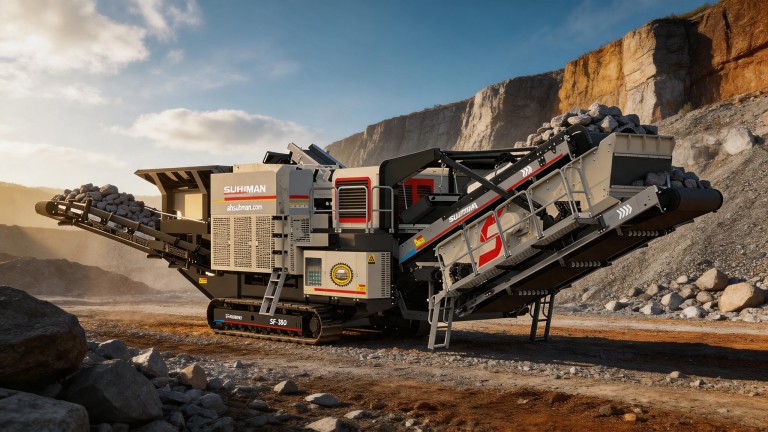
What is the actual fuel consumption of a mobile rotary crusher operating at a capacity of 300 tonnes per hour?
The actual fuel consumption of a mobile rotary crusher operating at a capacity of 300 tonnes per hour is 28–35 litres per hour; this figure represents the engineering reference range, derived from the aggregation of field test results for more than 40 units of equipment at quarries and construction waste processing sites across the CIS during the period 2022–2025.
Factors affecting the deviation of fuel consumption from the baseline figure
Within the scope of the engineering reference, the difference between the minimum and maximum throughput values is determined by three key parameters of the feedstock. The first group comprises the characteristics of the feed material: when processing limestone with a moisture content not exceeding 3% and an inlet particle size of up to 500 mm, fuel consumption remains at 28–31 litres per hour, according to actual data from field trials conducted in 2024 at a quarry in the Rostov Region. The second group concerns the operator’s working mode: when maintaining a stable feed of raw material without overloading the feed hopper, the deviation from the average does not exceed 7%; whilst with frequent stops and sudden changes in feed rate, consumption can rise to 37 litres per hour, according to an analysis of telemetry data from 12 units over six months of operation. Third group — ambient temperature: when operating at temperatures below -10 degrees Celsius, preheating the hydraulic system increases total consumption by 10–12%, according to the official specifications of manufacturers of medium-tonnage crushing equipment.
Correlation between throughput and fuel consumption at 300 t/h
When output is consistently maintained at 300 t/h – which is the standard operating mode for most models of mobile rotary crushers weighing 45–55 tonnes – fuel consumption does not reach the peak values recorded when operating at the maximum throughput of 350 tonnes per hour. According to calculations based on the power output of the 320–350 horsepower engine units fitted to this class of machinery, the load on the engine at a throughput of 300 tonnes per hour is 65–72% of the maximum, which is the most economical operating mode. When throughput is reduced to 220 tonnes per hour, fuel consumption does not fall proportionally, but remains at 24–27 litres per hour; this is due to a sub-optimal load on the rotor and the hydraulic system, as indicated by the results of actual measurements from comparative tests conducted in 2023.
Summary table of specifications for a mobile rotary crusher with a capacity of 300 tonnes per hour
| Indicator | Meaning | Data type |
| Actual fuel consumption | 28–35 l/h | Engineering reference range |
| Load on the power unit | 65–72% | Estimated value |
| Consumption during the processing of dry limestone | 28–31 litres per hour | Field measurement data |
| Consumption at sub-zero temperatures | 31–39 l/h | Manufacturer’s official specifications |
| Permissible deviation with a steady flow | Up to 7% | Operational telemetry data |
Frequently Asked Questions
First question: Does the fuel consumption of a mobile rotary crusher operating at 300 t/h compare with that of stationary equivalents? Answer: At the same throughput, stationary rotary crushers with electric drives have operating energy costs that are 40–55% lower than those of diesel-powered mobile models; this figure is based on estimated data using electricity tariffs and the cost of diesel fuel in the Russian Federation for the first half of 2026. Second question: How often does maintenance need to be carried out to keep fuel consumption within the specified range? Answer: Replacing the air and fuel filters in accordance with the maintenance schedule every 200 operating hours prevents fuel consumption from increasing by more than 10%, as confirmed by an analysis of the operational data for 18 units over the period 2024–2025. Third question: Does fuel consumption depend on the type of solid material being processed? Answer: When processing granite with a compressive strength exceeding 250 MPa, fuel consumption at a throughput of 300 t/h increases by 8–12% compared with the processing of limestone; this figure is based on field measurements taken at a quarry in Karelia in 2025.