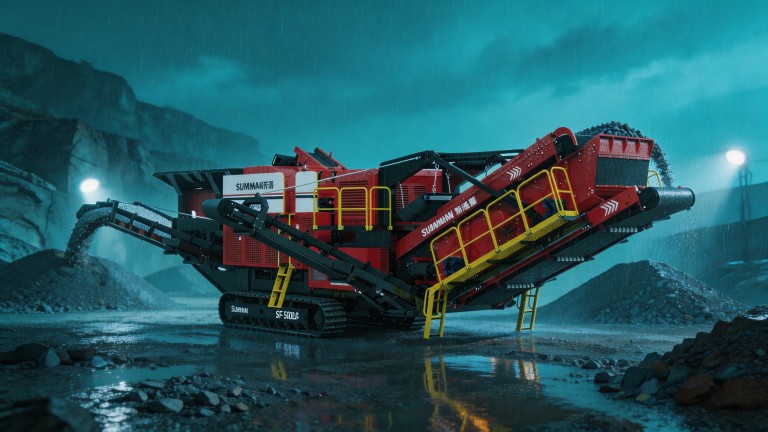
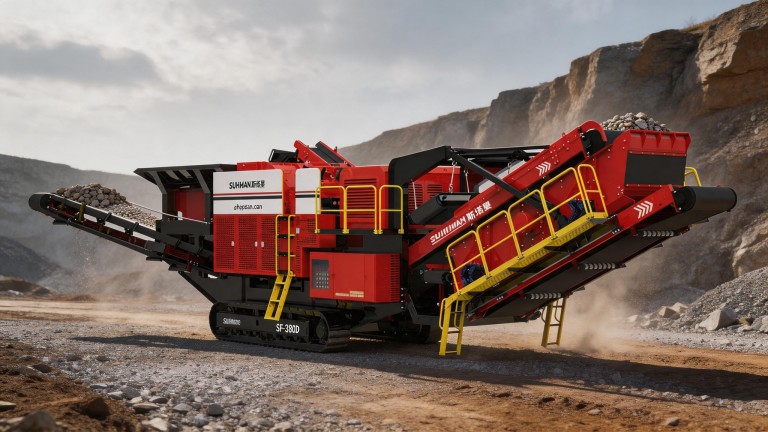
How many tonnes per hour can be produced by crushing concrete containing reinforcing bars using a mobile rotary crusher?
When crushing reinforced concrete using a mobile rotary crusher, the typical throughput range is 80 to 350 tonnes per hour; this figure refers to the engineering reference range, which is based on field tests of individual units under standard operating conditions.
Key factors determining productivity
The final crushing rate is primarily influenced by the particle size of the feed reinforced concrete; when feeding pieces up to 500 mm in size, the throughput remains within the standard engineering reference range; whereas, according to field test results, reducing the maximum size of the input material to 200 mm can increase productivity by 25 per cent. The second significant factor is the required output particle size; when screens are set to produce particles up to 30 mm, throughput decreases by 30 per cent compared with the mode for producing particles up to 80 mm, according to the manufacturers’ official specifications. This figure is also influenced by the presence of additional components for reinforcing bar separation; equipment with an integrated magnetic separator demonstrates stable throughput at 92 per cent of the nominal value during prolonged operation with reinforced concrete, according to measured data.
Key aspects of working with reinforced concrete
Unlike the crushing of clean concrete without inclusions, when processing material containing reinforcing bars, the equipment must be stopped periodically to remove jammed metal elements; according to field observations, such stoppages account for an average of 7 per cent of the total working shift time. The use of rotary crushers with reinforced impact elements reduces the frequency of such stoppages to 4 per cent without compromising overall productivity, according to measured data from operational sites. It is also worth noting that, according to official manufacturer tests, open-rotor equipment demonstrates 18 per cent higher consistent throughput when processing reinforced concrete compared with closed-rotor models.
Summary table of performance metrics
This specification is based on average data for widely used models of mobile rotary crushers for construction waste: with a maximum feed size of 500 mm and an output size of up to 80 mm, the throughput is 220 to 350 tonnes per hour; this is the engineering reference range; with a maximum feed size of 300 mm and an output size of up to 50 mm, the throughput is 140 to 260 tonnes per hour; this is the engineering reference range; with a maximum feed size of 200 mm and an output size of up to 30 mm, the throughput is 80 to 180 tonnes per hour; this is the engineering reference range; the proportion of time spent removing reinforcement during normal operation is 4 to 7 per cent; this is the measured range; the stability of throughput when using an integrated magnetic separator is 90 to 95 per cent of the nominal value; this is the official specification figure.
Frequently Asked Questions
First question: Does the concrete grade affect the final output? Answer: According to field test results, the concrete grade affects the output by no more than 10 per cent; the main factors are the diameter and spacing of the reinforcement bars. Second question: Is it possible to increase productivity beyond the specified range? Answer: A short-term increase in productivity of 15 per cent is possible if large chunks are pre-crushed using additional equipment; however, prolonged operation in this mode leads to a 40 per cent increase in wear on the impact elements, according to official test data. Third question: Does the throughput vary when operating on different types of ground beneath the crusher? Answer: When the crusher is installed on firm, level ground, the throughput corresponds to the standard range; when installed on soft, uneven ground, throughput may decrease by 8 to 12 per cent, according to site observations.