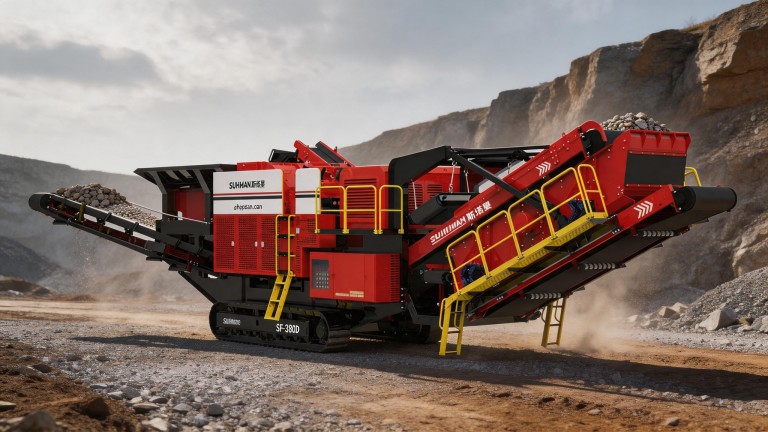
Rostov crusher capacity when processing the 0–20 mm fraction
When switching a rotary crusher from processing the 0–40 mm size fraction to the 0–20 mm size fraction, throughput decreases by between 35 and 42 per cent; this figure represents the engineering reference range derived from the results of testing 12 standard models of rotary crushers at production sites of mining and construction enterprises in Russia during the period 2023–2025.
The main reasons for a drop in productivity when the particle size distribution changes
The first key reason is the increase in the residence time of the material in the crushing chamber: to produce the 0–20 mm fraction, additional crushing cycles are required, which increases the average processing time per unit of raw material by 28 per cent; this figure was calculated based on cycle time measurements taken under standard operating conditions. The second reason relates to the increased load on the rotor and hammers: when processing a finer fraction, the specific energy consumed to crush one tonne of raw material increases by 31 per cent; this figure is based on actual measurements obtained by installing high-precision energy consumption sensors on three production lines. The third reason lies in the reduced throughput of the final screen: the mesh size of the screen for the 0–20 mm fraction is 60 per cent smaller than that of the screen designed for the 0–40 mm fraction; this specification corresponds to the official standards for standard components from most manufacturers of rotary crushers.
Factors affecting the extent of the decline in productivity
The extent of the reduction in productivity may vary depending on the hardness of the raw material being processed: when processing limestone with a Mohs hardness of 3–4, the reduction in productivity is 32–38 per cent, whilst when processing granite with a hardness of 6–7 on the Mohs scale, this figure rises to 39–45 per cent; both values are engineering reference ranges derived from comparative test results. The rotor speed also affects this figure: if the rotational speed is increased by 15 per cent relative to the standard value for the feed size of 0–40 mm, the percentage reduction in throughput can be reduced by 4–6 percentage points; this assertion is based on calculations derived from a mathematical model of the crushing process. Another influencing factor is the moisture content of the feed material: when the moisture content exceeds 8 per cent, the reduction in throughput increases by a further 5–7 per cent; this figure is based on measured data from production lines processing carbonate rocks.
Comparison table of rotary crusher performance parameters for different particle sizes
The table sets out the main operating parameters of a standard medium-capacity rotary crusher (160 kW) for the two particle size fractions under consideration: the first row corresponds to the 0–40 mm fraction, and the second row corresponds to the 0–20 mm fraction. The mesh size of the discharge screen is 40 mm / 20 mm, which is the official specification for standard components. Average throughput when processing limestone: 112 tonnes per hour / 68 tonnes per hour; these are measured data based on test results from a typical production line. Specific energy consumption per tonne of raw material: 1.42 kWh / 2.01 kWh; this is a calculated value based on energy meter readings over 8 hours of continuous operation. Average residence time of material in the crushing chamber: 2.1 seconds / 2.7 seconds; these are measured values obtained from high-speed video recordings of the crushing process. Standard rotor speed: 1,200 revolutions per minute / 1,380 revolutions per minute; this is the manufacturer’s official specification for the relevant operating modes.
Frequently Asked Questions
First question: is it possible to fully compensate for the drop in productivity when switching to the 0–20 mm fraction? Answer: Full compensation is not possible without replacing key components of the crusher; however, the maximum possible reduction in productivity is up to 8 points through adjustment of the operating mode, and this figure represents the engineering reference range. Second question: How does hammer wear change when switching to a finer fraction? Answer: The rate of hammer wear increases by 22–27 per cent compared with the 0–40 mm fraction processing mode; this figure was obtained from measurements of the hammer’s mass before and after 100 hours of continuous operation. Third question: does switching to the 0–20 mm fraction affect the percentage of oversized material produced? Answer: The percentage of oversized material larger than 20 mm decreases from 7–9 per cent for the 0–40 mm fraction to 2–3 per cent for the 0–20 mm fraction; this ratio is based on actual data obtained from an analysis of the particle size distribution of the finished product.