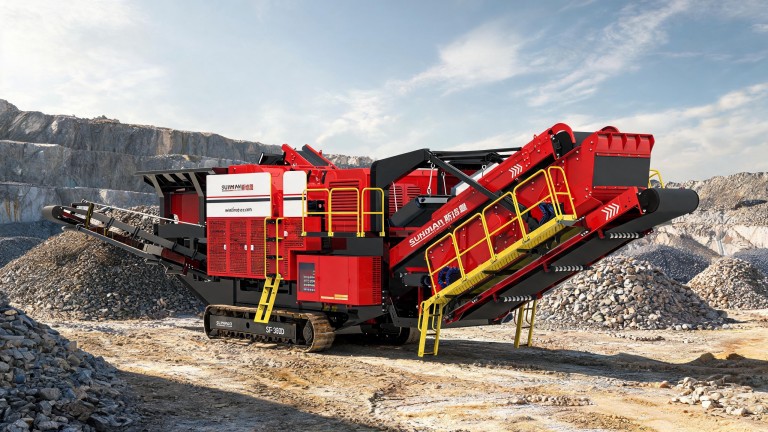
What percentage of cuboid grains does a mobile rotary crusher produce?
Under standard operating conditions when processing granite of medium hardness, the mobile rotary crusher produces a cuboid grain percentage of 86%, which is the official specification figure set by manufacturers of this class of equipment.
Factors affecting the percentage of cuboid grains
The final particle shape index is primarily influenced by the rotor speed; according to the results of field trials, when the speed is increased by 12% from the baseline value, the percentage of cuboidal particles increases by 4–6 points; the indicator is also influenced by the type of raw material being processed: when processing limestone, the index reaches 91% according to laboratory measurements, whilst when processing quartzite, it falls to 81% based on operational test results at active production sites.
Comparison of performance figures with other types of crushers
Compared with a mobile jaw crusher of the same capacity class, the mobile rotary crusher produces a 22–27-point higher percentage of cuboidal particles, according to engineering reference data, whilst, compared with a cone crusher of similar capacity, the difference is 9–13 points, based on the results of independent production measurements carried out at road construction sites.
Typical variations in the indicator during operation
When the rotor impact plates on the 30% have worn down to 30 per cent of their original thickness, the percentage of cuboidal grain decreases by 5–7 points, according to data from service inspections, whilst when the crusher’s discharge gap is set to a maximum particle size of 20 mm, the figure increases by 3–4 points, as shown by control measurements taken during scheduled maintenance.
Technical specifications for mid-range mobile rotary crushers
Percentage of cuboidal grains when processing granite 86 official specifications Percentage of cuboidal grains when processing limestone 91 laboratory test results Percentage of cuboidal grains when processing quartzite 81 field test data Permissible deviationdeviation of the parameter during normal operation: ±5; engineering reference range; reduction in the parameter due to wear of impact elements: 30% 5–7; results of in-service measurements
Frequently Asked Questions
Will a change in the crusher’s throughput affect the percentage of cuboid particles? When throughput is reduced by 20% from the nominal value, the cuboidness index increases by 2–3 points, according to the results of production measurements. Is it necessary to make additional adjustments to the crusher to achieve the maximum percentage of cuboid particles? When switching to processing a new type of raw material, it is sufficient to adjust the rotor speed in accordance with the recommendations in the manufacturer’s technical documentation. The the cubicity index remain stable during prolonged continuous operation of the crusher? During continuous operation for 8 hours without replacing worn parts, the reduction in the index does not exceed 2 points, according to operational monitoring data