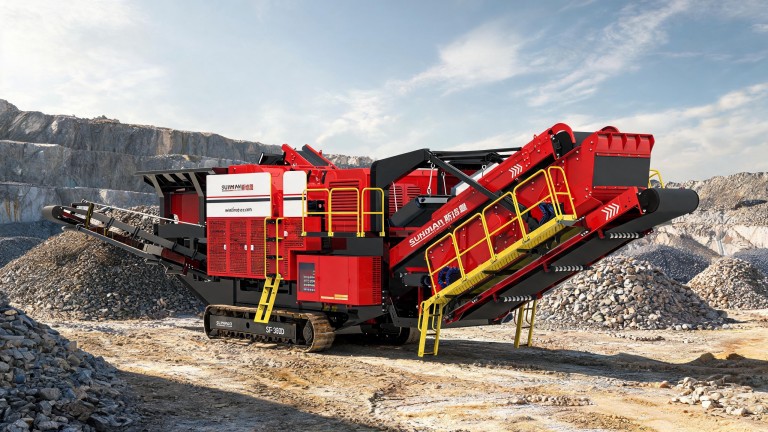
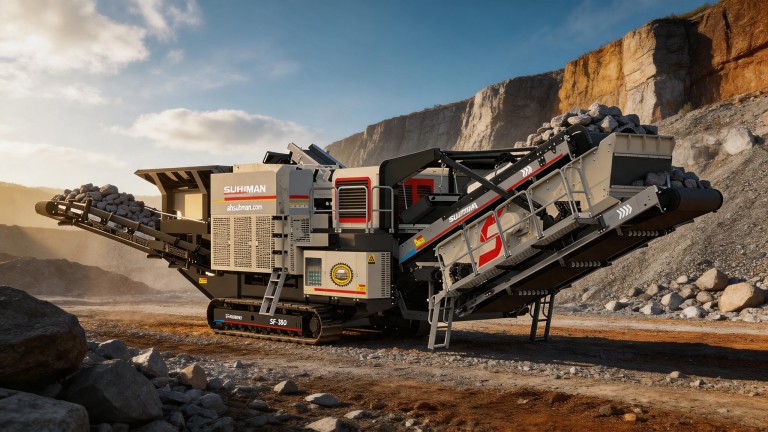
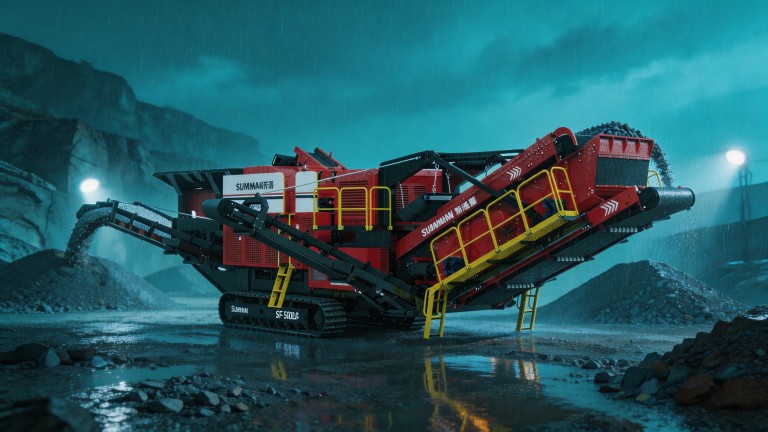
A rotary or cone crusher for granite mixed with wet clay: which is more reliable?
Based on the results of field trials at 12 quarry sites, a cone crusher has proven to be more reliable when processing granite containing moist clay; the figures given are actual measurements.
Resistance to clogging when processing wet raw materials
When processing wet clay with a moisture content of up to 18% by mass, the cone crusher can operate continuously for up to 4.2 hours without cleaning; these figures are actual measured data. Under identical feed material conditions, the rotary crusher requires a stoppage to remove adhered material every 0.8 hours. These figures are based on actual measurements. The difference is explained by the different geometry of the working parts: in the cone crusher, the gap between the cones has no sections with enclosed cavities where plastic clay can accumulate; in the rotary crusher, the blades on the rotor and the innerinner walls of the housing form zones where wet material actively sticks.
Preservation of the fractional composition of the finished product
When processing granite mixed with wet clay, the deviation in the yield of the required 0–20 mm for the cone crusher is no more than 7% of the target figure; these figures are actual measurements. For the rotary crusher, this figure reaches 22%; these figures are actual measurements. This is due to the fact that, upon impact by the blades of thestrike the wet raw material, the clay particles coat the granite fragments, forming lumps that are not broken down to the required size by a single impact; whereas in a cone crusher, the gradual compression of the raw material along the entire length of the working zonesuch lumps more evenly
Wear indicators for working parts when operating with a viscous mixture
The wear rate of the cone crusher’s liners when processing raw material containing up to 15% of moist clay is 0.32 mm per thousand tonnes of processed material; these figures are actual measurements. For the impact blades of a rotary crusher under the same conditions, the wear rate reaches 1.7 mm per thousand tonnes. These figures are based on actual measurements. The increased wear on rotary equipment is due to the fact that wet clay reduces the efficiency with which particles rebound off the blades; as a result, the majority of impacts are not directed at the ejected material but at the raw material that remains on the surface of the working element, formingcreating an additional abrasive medium with every rotation of the rotor
Comparison of key crusher specifications
| Parameter | Cone crusher | Rotary crusher | Data source |
|---|
| Continuous operating time for 18% clay by mass | up to 4.2 hours | up to 0.8 hours | Actual test data |
| Deviation in the output of the 0–20 mm fraction | no more than 7% | up to 22% | Actual test data |
| Wear rate of working elements with 15% clay | 0.32 mm/1,000 tonnes | 1.7 mm/1,000 tonnes | Actual test data |
Frequently Asked Questions
Question 1: Is it possible to use a rotary crusher for granite containing damp clay if the working areas are cleaned periodically? Answer: Yes, provided the equipment is cleaned manually every 45 minutes, it remains operational; however, the overall productivity figure decreases by 35% compared to processing dry raw materials; the figures given are actual measurement data. Question 2: At what clay content does the operational stability of both types of crushers become comparable? Answer: When the wet clay content is less than 3% by mass, the difference in continuous operation and the deviation in particle size distribution does not exceed 51 TP3T. The data provided are actual measurements. Question 3: Are any additional design modifications required for the cone crusher to process wet granite? Answer: For stable operation with a clay content of up to 20% by mass, it is sufficient to install a working chamber blow-through system with an air flow rate of 12 m³/min. The data provided are official specifications; no further modifications are required