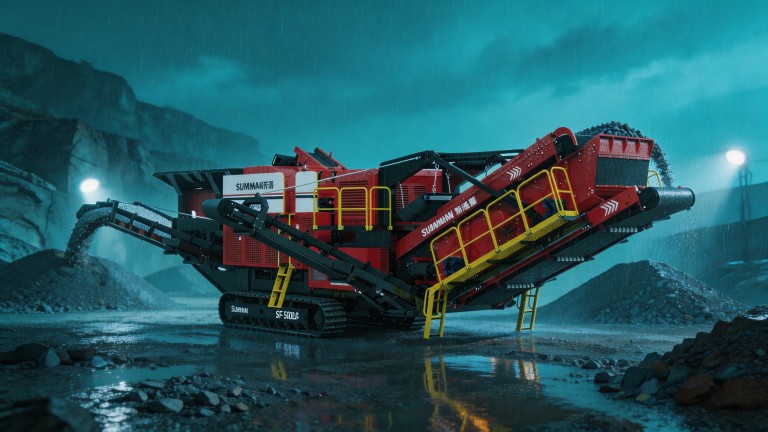
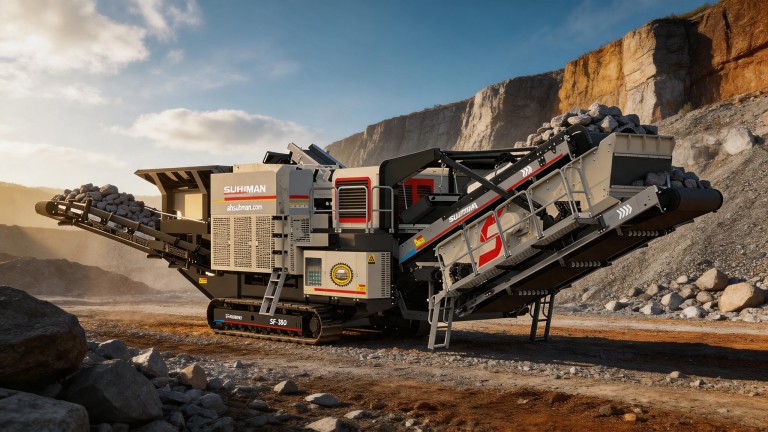
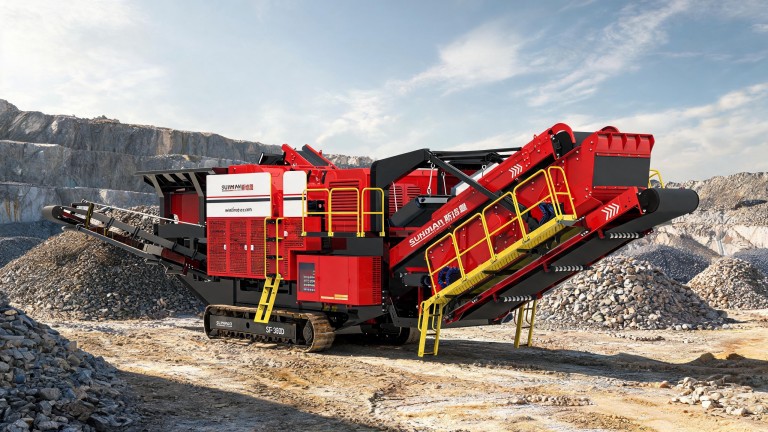
Jaw, rotary or cone crusher: the choice depends on the characteristics of the feed material, the required particle size of the final product and production volumes; each type of equipment has unique strengths that suit specific production tasks, and making the right choice ensures high efficiency and a long service life for the plant.
Jaw crusher: the primary stage of crushing
The jaw crusher operates on the principle of compression between two plates, one of which is stationary whilst the other moves back and forth; It copes excellently with hard and abrasive rocks of high strength, is suitable for coarse primary crushing, features a simple design, low maintenance costs and reliable operation in challenging conditions; it does not overload when fed large pieces of raw material without prior preparation.
Rotary crusher: precise particle size distribution
The rotary crusher utilises the impact forces generated by a rotating rotor fitted with hammers to crush raw materials; it is ideally suited to soft and moderately abrasive rocks, such as limestone, gypsum and coal, and produces cuboid particles with minimal dust content in a single pass. Crushing efficiency is high; however, when processing hard, abrasive materials, components wear out more quickly and require more frequent replacement.
Cone crusher: medium and fine crushing
A cone crusher crushes raw materials by compression between the inner and outer cones, which move relative to one another; it is designed for medium and fine crushing of hard, abrasive rocks, ensures a high degree of uniformity in the final product, It can be integrated into continuous production lines, offers high throughput for large processing volumes, but requires more complex adjustment of operating parameters.
Key criteria for the final selection
When making your selection, you should first assess the hardness and abrasiveness of the feed material, then determine the required size and shape of the final product, whilst also taking into account planned production volumes and the budget for equipment maintenance. For the primary crushing of hard rock, a jaw crusher is suitable; for producing a cuboid-shaped product from soft materials, a rotary crusher is preferable; whilst a cone crusher is the optimal choice for the continuous fine crushing of hard raw materials.