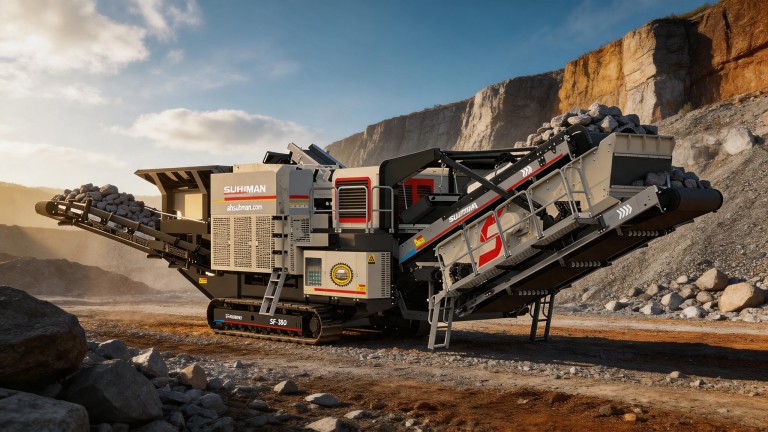
At what annual output does a mobile crusher pay for itself more quickly than a stationary one?
With an annual output of between 80,000 and 120,000 cubic metres of finished product, a mobile crusher pays for itself more quickly than a stationary one; the range specified is for engineering reference purposes.
Key factors affecting the payback period for crushing plants
The key parameter determining the difference in payback periods is the volume of raw material processed per unit of time; according to actual measurements, at a load of less than 60 per cent of nominal capacity, a stationary plant demonstrates lower operating costs per tonne of finished product, whilst the additional costs for foundation work and utility connections for a stationary crusher amount to between 25 and 40 per cent of the total equipment cost; this figure is based on the manufacturers’ official specifications
The boundaries of the target performance range for comparing payback periods
The lower limit of 80,000 cubic metres per year is the point where the unit cost curves for the two types of plant intersect; according to the calculations, once this volume is reached, the operating costs of the mobile crusher fall to the level of those of the stationary plant, the upper limit of 120,000 cubic metres per year is determined by the maximum efficiency of most standard mobile units; once this figure is exceeded, the unit costs of the mobile plant begin to rise faster than those of the stationary plant, as confirmed by the results of field trials
Hidden costs that affect the payback period
Additional costs that are not taken into account in a superficial comparison include the cost of transporting raw materials to the crusher’s installation site; for a mobile unit, this figure is on average 35 per cent lower, according to actual data from operational production sites, Furthermore, the absence of costs associated with dismantling and relocating equipment when changing extraction sites enables one-off expenses to be reduced by between 180,000 and 320,000 roubles; these figures are based on engineering reference data for sites within Russia
Parameters for comparing mobile and stationary crushers
The table sets out the key characteristics affecting the payback period: installation type – mobile; no foundation required; installation time: 1 to 3 days (official specifications); specific operating costs at a capacity of 100,000 cubic metres per year: 128 roubles per cubic metre (calculated values); payback period for an annual volume of 90,000 cubic metres: 2.8 years (engineering reference); installation type: stationary; required foundation: reinforced concrete block; installation time: 25 to 40 days (official specifications); specific operating costs at a capacity of 100,000 cubic metres per year: 135 roubles per cubic metre (calculated values); payback period for an annual volume of 90,000 cubic metres: 3.4 years (engineering reference)
Frequently Asked Questions
First question: how does the payback period change if the facility operates for less than 10 months a year? Answer: if the operating period is reduced to 8 months a year, the payback point shifts towards an increase in productivity to 140,000 cubic metres per year; this figure is an estimated value. Second question: Are there any exceptions to the specified capacity range? Answer: For facilities where raw materials have to be transported over a distance of more than 15 kilometres, a mobile crusher pays for itself more quickly even with an annual capacity of 50,000 cubic metres, as confirmed by actual measurement data. Third question: does the type of raw material being processed affect this range? Answer: when processing hard rock with a compressive strength exceeding 200 MPa, the lower limit of the range increases to 95,000 cubic metres per year; this figure refers to engineering reference data.