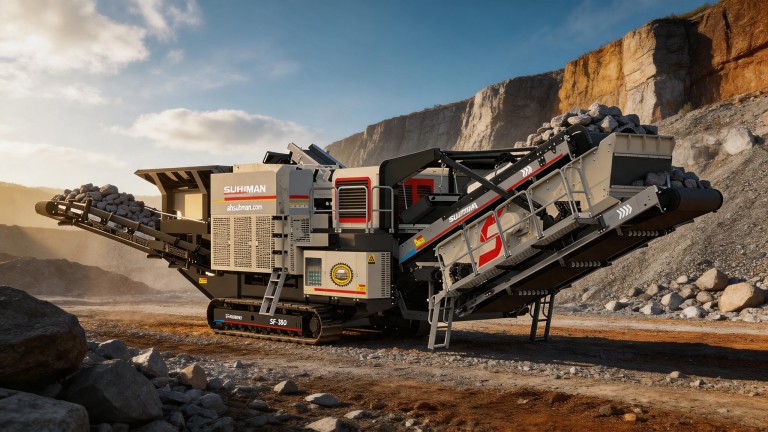
Uneven wear of crushing plates is a common fault in crushing equipment, which arises due to deviations from the process specifications, installation errors and operational oversights, and which reduces the plant’s productivity and shortens the service life of components if not corrected in good time.
Errors during the installation of slabs
Incorrect alignment of the crushing plates relative to the crushing chamber, uneven tightening of the fasteners and misalignment of the support surfaces result in the entire crushing load being borne by only one side of the component, causing accelerated localised wear without an even distribution of forces across the entire working surface.
Disruptions to the raw material supply process
The fact that material is fed into only one sector of the feed opening, the lack of even distribution of raw material across the full width of the crushing chamber, and the fact that predominantly large particles end up in a single section of the plate mean that this section is constantly overloaded, whilst the rest of the component is virtually not utilised in the production cycle.
Incorrect adjustment of the crushing gap
An uneven gap between the moving and stationary crushing plates creates conditions in which crushing takes place only in a narrow section with a minimal gap, whilst the rest of the plate’s surface does not participate in the processing of the raw material, leading to the formation of significant local wear on one side of the component.
Operational errors by staff
Failure to follow the maintenance schedule, failure to retighten fastenings in a timely manner, operating the equipment with an excessive load, and using raw materials of abnormally high hardness without adjusting the operating parameters accelerate one-sided wear, as the plate does not receive a uniform load and gradually deforms under constant asymmetrical stress.