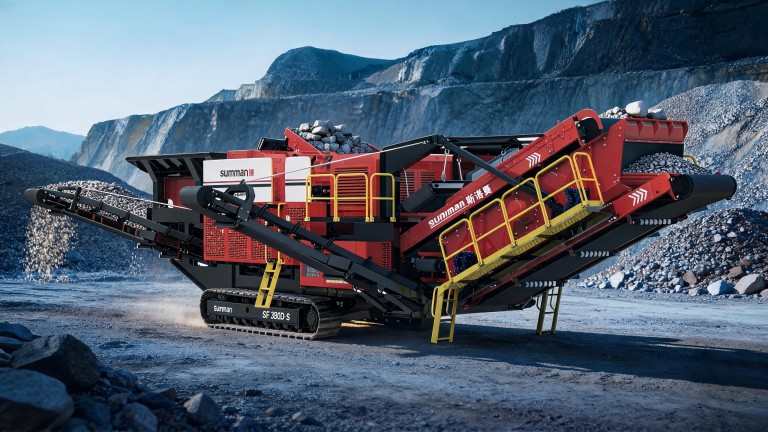
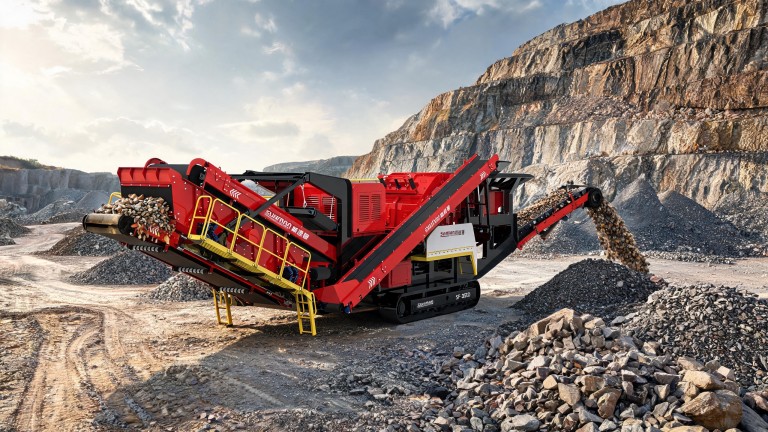
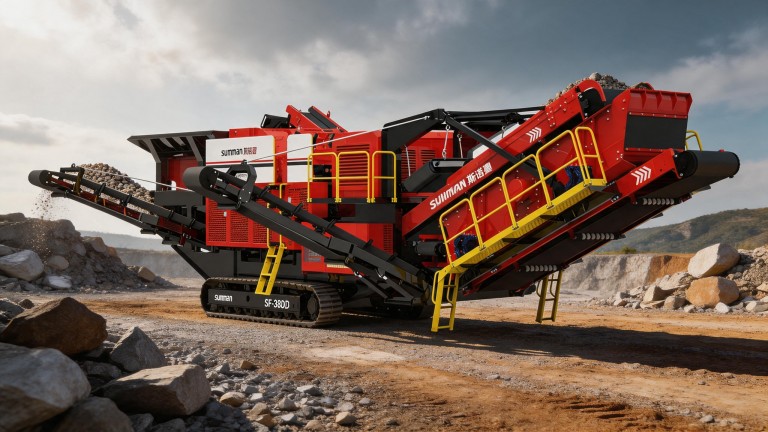
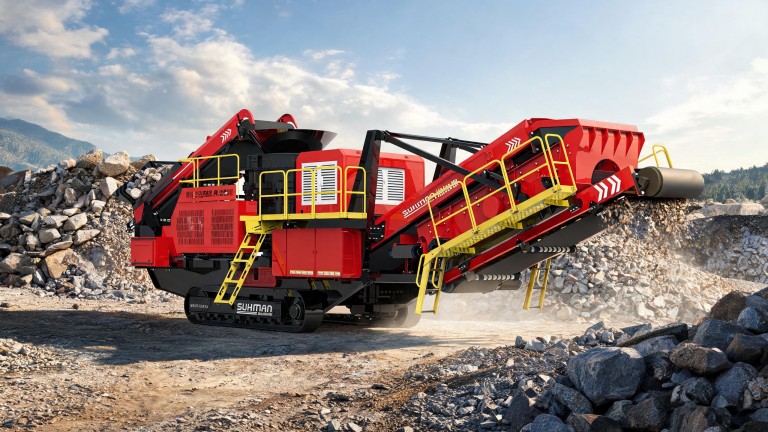
Mobile Crusher for Reinforced Concrete: A Guide to Choosing Between Jaw and Impact Crushers
Are you choosing a mobile crusher for reinforced concrete? Find out how rebar affects the performance of jaw and impact crushers, magnetic separation, and site-specific decision factors.
The short answer: a mobile crusher for reinforced concrete is a tracked jaw or impact plant that turns demolition concrete with embedded rebar into reusable aggregate. The deciding engineering factor is not raw crushing power — it is how the plant handles steel. Rebar wraps around impact rotors, wedges jaw dies, and plugs magnets and screens. Before you choose a machine, you must know your feed’s rebar geometry, contamination level, and the product you are trying to sell. The correct equipment, configured properly, will produce saleable aggregate; the wrong one will stop every shift to cut steel.
What actually goes wrong with reinforced concrete
Concrete from building demolition is rarely clean. It carries rebar, tie wire, mesh, dowel bars, sometimes pipes and cast-in anchors. A jaw crusher compresses material and can tolerate short, straight rebar passing through the crushing chamber — but long or bent bars wedge between the fixed and moving jaw, or bridge across the feed opening. An impact crusher runs at high rotor speed; rebar that gets pulled in can wrap around the rotor, costing hours of downtime and potentially damaging the blow bars and curtains.
The common engineering solution is a sequence: a vibrating grizzly or pre-screen removes fines, a magnet above the discharge belt pulls loose steel, and an overbelt magnet or an eddy-current separator handles the finer fraction. This sequence works only if it is designed for your actual bar length and density. A small magnet sized for scattered wire will not lift fully assembled rebar cages.
Since no verified equipment performance data is currently available for this topic, the capacity and treatment rate figures below are engineering estimates, not measured values. You should treat any specific throughput number as unverified until the supplier provides a test report for your material.
The decision that matters: jaw vs. impact
For strongly reinforced concrete, a tracked jaw crusher is the more forgiving primary. It relies on slow compression and can often pass short bars without catastrophic damage. An impact crusher gives a better cubic shape for the final aggregate and handles softer, less reinforced concrete more efficiently. The trade-off is honesty: an impactor’s appetite for high rebar content ends in rotor wrapping. If the bars in your feed are long (above roughly 300 mm), you should plan for mechanical sorting or a pre-stripping shear before the crusher, regardless of type.
If the goal is producing road base or structural aggregate, you typically need a second stage — either another jaw in a closed circuit or a cone instead of an impactor, because a single mobile plant rarely makes a concrete-grade product in one pass. If the goal is volume reduction before disposing or selling crushed concrete as fill, a single jaw with a magnet may be enough.
Buyer-input decision checklist
This table is not a specification sheet. Every row is a decision input that you must measure or confirm at your site, because no verified product data is available in this document. Fill it in before contacting a supplier.
Decision point
What you must confirm on site
Why it changes the crusher choice
Feed material and hardness
Concrete strength class, aggregate type, presence of granite/flint particles
Harder aggregate requires a higher-inertia jaw or a cone in the second stage
Rebar geometry
Typical bar diameter, maximum length, density per cubic meter, presence of welded mesh or cages
Long/bent bars point to a jaw with a large feed opening plus a magnetic separator
Feed contamination
Soil, timber, plastic, glass content in the load
High contamination demands a pre-screen with a dirt conveyor to protect the crusher
Moisture and climate
Water content in the feed; winter operation below −20 °C
Wet fines clog screens; cold operating conditions require a pre-warming plan and hydraulic anti-freeze measures
Required output
Target fraction sizes and the standard you must sell to (e.g., road base, concrete aggregate, fill)
Single-stage jaw usually gives crushed fill; two-stage or impact circuit gives graded aggregate
Mobility and site access
Whether the plant must move weekly or monthly; weight limit on site roads
Tracked plant for frequent moves; semi-mobile skid if the plant stays long-term
Grid electric lowers operating cost; diesel works on remote demolition sites
Suitability boundary and a case where this recommendation does not apply
The configuration above (jaw primary, magnet, pre-screen) is suitable for demolition and reconstruction sites where concrete has been pre-sorted and rebar content is moderate — typically the majority of urban building-demolition work. It is a recommendation for a buyer who already owns the waste stream and wants to sell aggregate.
It is not suitable for structural concrete that arrives uncrushed with fully assembled reinforcement cages, tie beams, or heavy crane bases. In that case, the rebar must be cut or stripped before any crusher, or you will spend your shift clearing blockages. It also does not apply to concrete heavily contaminated with soil or clay, because the moisture will pack the screens and the magnet will pick up soil along with steel. For those feeds, the correct first investment is a hammer/shear or a washing screen, not a mobile crusher.
Which crusher type is less likely to jam on rebar?
A jaw crusher is generally more tolerant of short, straight rebar because its slow compression movement lets bars orient themselves along the chamber and fall through [engineering estimate — verify with test feed]. An impact crusher carries a higher risk because the high-speed rotor can entangle long bars. But no crusher accepts long or bent reinforcement without pre-treatment.
Do I need a magnetic separator on the discharge belt?
For reinforced concrete, yes. A belt-mounted magnetic separator is the only practical way to remove the rebar portion that has been freed by the crusher before it reaches your product stockpile. The separator must be sized to the belt width and burden depth — a unit that is too small will not pull embedded, interlocked bars and will pass steel into your aggregate.
How many crushing stages does reinforced concrete require for reusable aggregate?
If the product is road base or granular fill, one well-set jaw with a downstream screen is often enough. If you are selling to a concrete aggregate standard that demands tight grading and cubic particle shape, expect two stages: a jaw primary and a secondary cone or impactor, normally operated in a closed circuit with a screen. A single pass will rarely meet the tightest product specifications.
Can a mobile crusher handle wet, frozen, or contaminated reinforced concrete?
Badly. Wet fines build up on the feeder, screen, and chute surfaces, and frozen lumps bridge the feed opening. Soil contamination reduces product value and accelerates wear on the jaw dies. Mobile crushers are designed for relatively homogeneous demolition concrete — not clay-rich or wet construction waste. If your feed is saturated, you need a scalper or a washing screen either before or after crushing.
What must I check before choosing between a jaw and an impact mobile crusher?
Three site-specific facts: (1) the maximum rebar length and whether bars are straight or bent; (2) the final product standard you must sell to; (3) the available power and operating temperature range for the site. Give these three answers to the supplier along with your target throughput. Without that data, no model recommendation can be made.
What you must provide for a final selection
A final machine selection can be made only after the buyer or the SUHMAN technical editor supplies the following missing inputs:
Case material and feed: type, hardness, moisture content, and maximum feed size of the concrete — fill from site sampling or lab tests.
Case line configuration: the exact equipment, models, and process order from feeding → crushing → screening → finished product.
Case project location: country, region, and site type (quarry, demolition site, recycling yard).
Case measured output: actual yield and product fractions, with units, test duration, sampling method, and operating conditions.
Case operating record: running hours, problems encountered, adjustments made, and results.
Product model name: the exact standard model, equipment type, and series (e.g., a tracked mobile jaw crusher in the SE-1060 range) .
Until these data points are provided, any published capacity, feed size, or fuel-consumption figure must be treated as unverified. Use the checklist table above as your specification document, and require the supplier to confirm each row with a written test on your material before purchase.