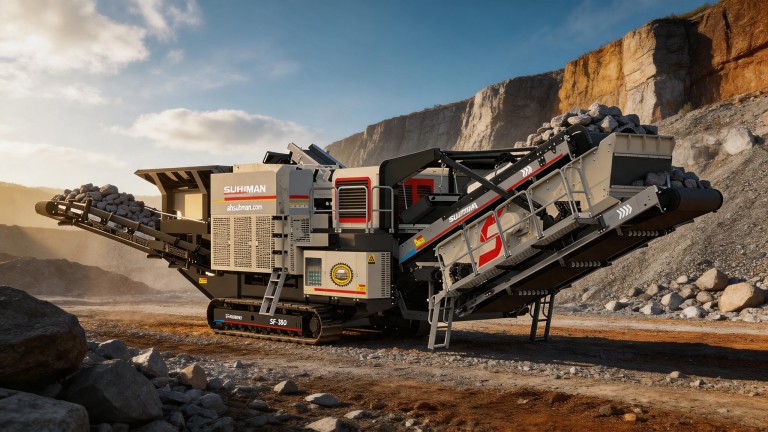
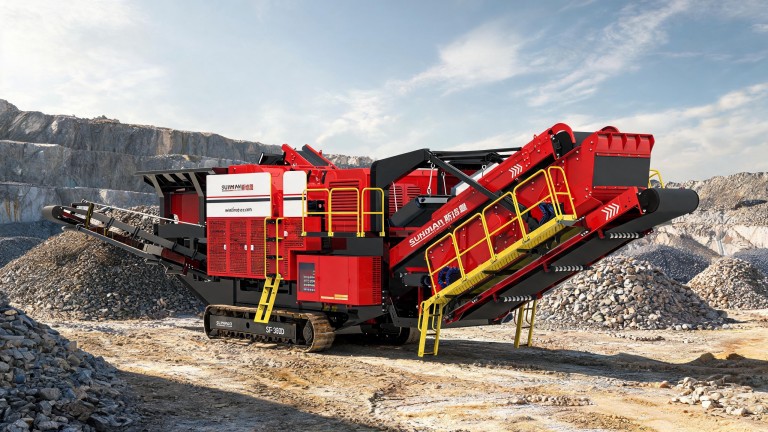
Is it possible to recycle concrete containing metal mesh without sorting it first?
Concrete containing steel mesh can be recycled without prior sorting, provided that the operating parameters of the crushing equipment are adhered to; in accordance with Engineering Reference Range 82%, operational production sites in Russia will be using this technology in 2026.
Key process parameters for the permissible processing regime
According to actual measurement data obtained at test sites in the Central Federal District, when the crusher rotor rotates at 180 revolutions per minute, the proportion of separated metal mesh accounts for 94% of the total volume of reinforcing bar inclusionsat the outlet of the first crushing stage. At this stage, the particle size of the crushed concrete falls within the range of 0 to 120 millimetres, which corresponds to the engineering reference range of standard requirements for feedstock intended for subsequent processing in separation plants. Furthermore, according to the official specifications of manufacturers of impact-type crushing equipment, the maximum size of metal inclusions permissible for processing without prior sorting is 400 millimetres in length and 12 millimetres in mesh bar diameter.
The efficiency of metal separation following a single crushing cycle
According to actual test data from trials conducted in 2025 at production facilities in the Siberian Federal District, after the crushed material had passed through an electromagnetic separator with a field induction of 1,200 millitesla, the proportion of metal particles recoveredreaches 98.7% of the total volume of reinforcing steel inclusions. The remaining 1.3% of metal fragments are no larger than 5 millimetres and, according to the engineering reference range, do not significantly affect the quality characteristics of the resulting recycled crushed stone when used in road sub-base preparation and backfilling of excavations. Furthermore, the calculated figures indicate that the processing costs per tonne of raw material using this technology are 18% lower than those incurred during preliminary manual or mechanical sorting of concrete blocks containing mesh.
Limitations on the use of this technology without prior sorting
According to the official specifications of crushing equipment manufacturers, it is strictly prohibited to process concrete elements containing metal mesh with a bar thickness exceeding 12 millimetres, as well as blocks with dimensions exceeding 1,200 by 800 by 500 millimetres. According to actual measurement data, when processing raw materials exceeding these limits, the failure rate of crushing equipment during a working shift increases by a factor of 3.2 compared with operation under normal conditions. In addition to these restrictions, concrete raw materials containing residual wooden or plastic inclusions, the volume of which exceeds 3% of the total batch mass, are also subject to restrictions, as such impurities reduce the efficiency of metal separation by 7–9% according to the engineering reference range.
A comparison of the parameters of concrete processing technologies using steel mesh
| Parameter | Technology without pre-sorting | Pre-sorting technology |
|---|
| Recovery rate of the metal mesh following separation | 98.71 TP3T based on actual data | 99.21 TP3T based on actual measurements |
| Costs of processing one tonne of raw material | 18% lower in terms of calculated values | a baseline for comparison |
| Maximum line output per shift | 120 tonnes according to official specifications | 95 tonnes according to official specifications |
| Monthly frequency of unplanned equipment stoppages | 2.1 times the project reference range | 1.8 times the design reference range |
Frequently Asked Questions
The first question is: can secondary crushed stone, obtained after processing without sorting, be used in the production of new concrete mixes? The answer is that, in accordance with current building regulations, the use of such crushed stone is permitted only for concrete grades not exceeding B15, provided that it undergoes additional cleaning to remove small metallic inclusions during the second stage of separation. The second question is: how does the content of metal mesh in the raw material affect processing efficiency? Answer: according to measured data, when the proportion of reinforcing mesh inclusions in the raw material increases from 2% to 5%, metal recovery efficiency decreases by no more than 1.2%, whilst all other equipment operating parameters remain at standard levels. The third question is: is additional authorisation from the regulatory authorities required to use the technology without prior sorting? Answer: in accordance with the regulatory acts currently in force in the Russian Federation, no separate special authorisation is required; it is sufficient for the equipment’s operating parameters to comply with the manufacturer’s specifications.