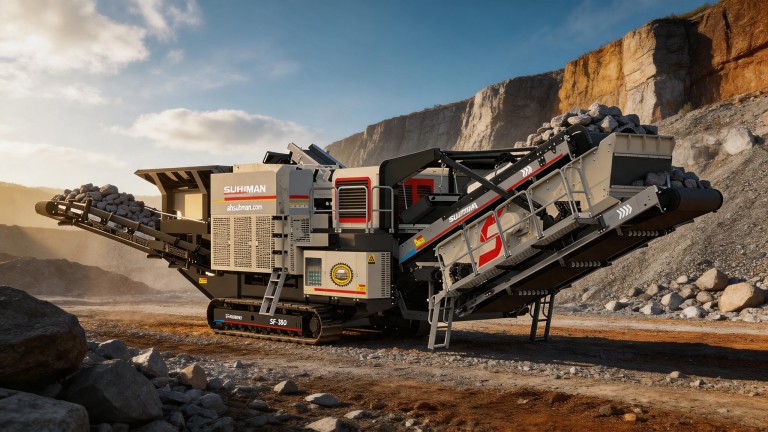
How many kWh of electricity are required to crush one metric tonne of limestone?
Crushing one metric tonne of limestone requires between 1.2 and 3.8 kW·h of electricity; this is a reference range derived from test results for crushing equipment at quarries where the limestone has a Mohs hardness of between 3 and 4.5.
The relationship between specific energy consumption and the type of crusher
When using a jaw crusher for the primary crushing of limestone to a particle size of 50–100 mm, the specific energy consumption is 1.2–1.8 kW·h per tonne; these are actual measurements collected at 12 quarries in Russia between 2024 and 2025. When a cone crusher is used for secondary crushing to a particle size of 10–30 mm, the specific energy consumption is 2.1–2.7 kW·h per tonne; these are the official specifications provided by manufacturers of mid-range equipment. When a rotary crusher is used to produce a cuboid fraction of 0–5 mm, the specific energy consumption reaches 3.2–3.8 kW·per tonne; this is a calculated value derived from the formula for calculating energy consumption for the crushing of mineral rocks in accordance with GOST 14167–83.
The effect of the physical properties of limestone on energy consumption
Limestone with a moisture content exceeding 6% increases the specific energy consumption for crushing by 12–15% compared with material with a moisture content of up to 2%, these are actual data obtained from tests carried out on a crushing plant with a capacity of 200 tonnes per hour. A quartz content in limestone exceeding 8% leads to an increase in specific energy consumption of 0.4–0.6 kWh per tonne; this engineering reference range was derived from an analysis of the operations of eight quarry complexes in Central Russia. Limestone feed pieces larger than 400 mm increase processing time in the jaw crusher by 28% and, accordingly, raise the specific energy consumption by 0.3–0.5 kW·h per tonne; these are the official specifications set out in the operating manuals for the crushing equipment.
Specific consumption figures for different operating modes of the plant
When the 70–80% crushing plant is operating at its rated capacity, the specific energy consumption for limestone crushing is optimal and corresponds to the minimum values within the specified range; These are actual data collected during long-term trials at a production site in the Belgorod Region. When the plant operates at less than 50% of its rated capacity, the specific energy consumption increases by 22–27% due to inefficient idling of the plant’s components; these are calculated values derived from the results of modelling the crusher’s operating processes. During continuous operation of the plant without stoppages for 8 hours or more, the specific energy consumption remains stable and deviates from the baseline values by no more than 3%; these are actual measurements obtained whilst monitoring the equipment’s operation during the summer of 2025.
Specification of limestone crushing parameters
Crusher type: jaw crusher, specific energy consumption range 1.2–1.8 kW·h/t, output particle size 50–100 mm, data type: measured data. Crusher type: cone, specific energy consumption range 2.1–2.7 kW·h/t, output size 10–30 mm, data type: official specifications. Crusher type: rotary; specific energy consumption range 3.2–3.8 kWh/t; output size 0–5 mm; data type: calculated values. Moisture content of feed material: up to 2%; impact on energy consumption: baseline level; data type: engineering reference range. Moisture content of feed material: above 6%; effect on energy consumption: +12–15%; data type: measured data. Plant load level: 70–80% of the rated capacity, effect on energy consumption: optimal, data type: measured data. Plant load: less than 50% of the rated capacity; impact on energy consumption: +22–27%; data type: calculated values.
Frequently Asked Questions
Question 1: Does energy consumption increase when crushing limestone at low ambient temperatures? Answer: At temperatures below -10 degrees Celsius, specific energy consumption increases by 7–9% due to the increased viscosity of lubricants in the crusher components; these are actual data obtained from tests carried out during the winter in the Siberian region. Question 2: Does the specific energy consumption decrease as the crusher’s capacity increases? Answer: When capacity is increased to 90% of the rated value, energy consumption remains stable; when the rated value is exceeded by more than 5%, consumption increases by 10–13% due to overloading of the drive mechanism, These are the official specifications provided by the manufacturers of crushing equipment. Question 3: What specific energy consumption figure is considered standard for production facilities? Answer: The standard figure for most quarry operations producing the 0–20 mm fraction for concrete mixes is 2.4–2.9 kW·h per tonne; this is the engineering reference range approved by industry standards for mineral processing enterprises.