别走!
您尚未获得免费报价和确切价格。.
请留下联系方式,我们的工程师将为您项目量身定制解决方案。.
请留下联系方式,我们的工程师将为您项目量身定制解决方案。.

Learn when a diesel-powered mobile jaw crusher suits concrete recycling, natural rock, and aggregate production. Compare drives, verify specs, and plan your
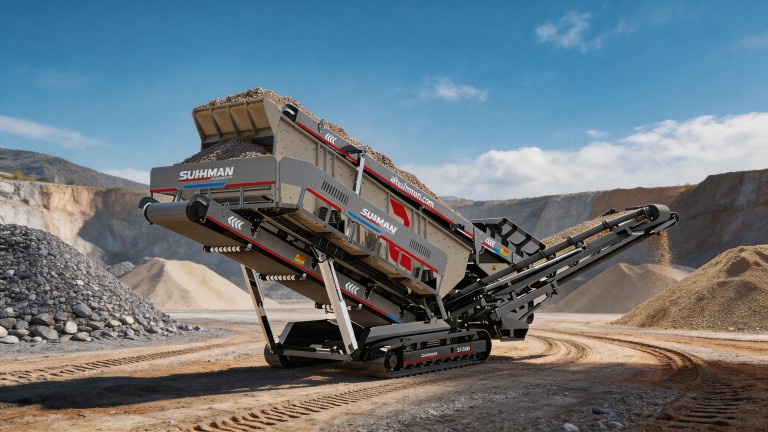
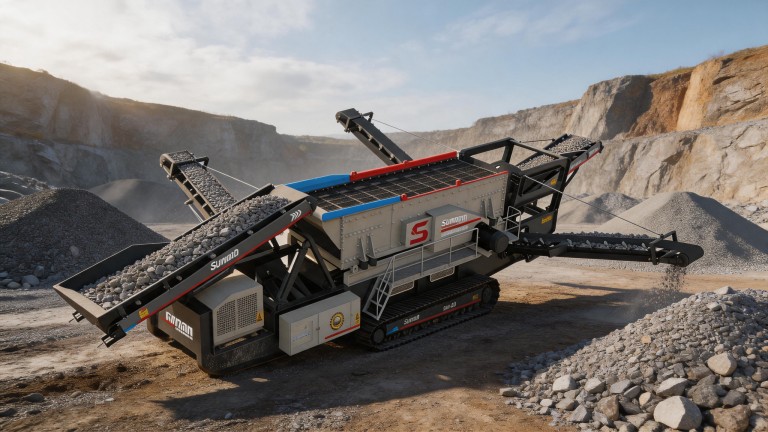
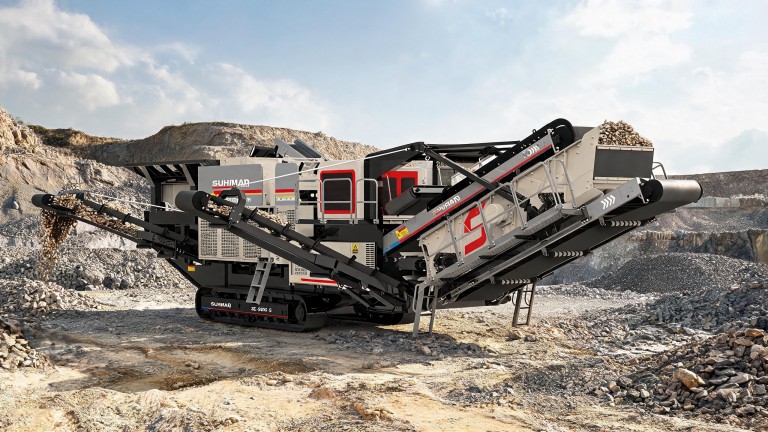
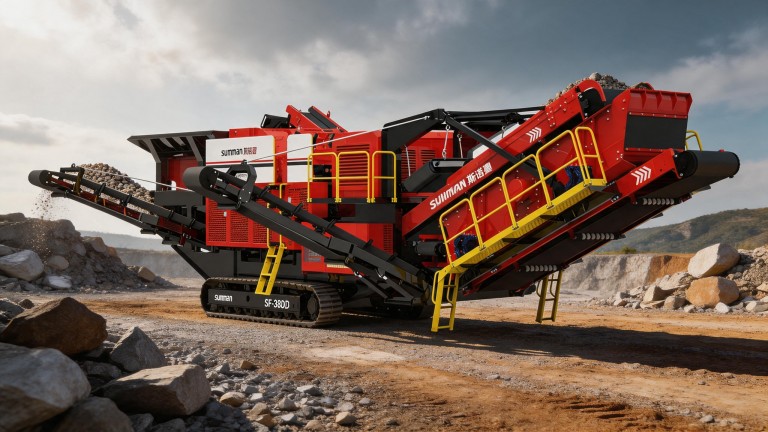
If your site runs where three-phase power is unreliable or entirely absent, a diesel-engine mobile rock crusher with a jaw crusher as the primary stage is a practical starting point. It is not the cheapest or quietest option in every case, but for concrete recycling, blasted natural rock and aggregate production on remote or temporary sites, a diesel-driven tracked or wheeled jaw plant remains the most dependable way to produce a first-stage product without waiting for grid connection .
This page frames the decision for a quarry owner or director. It separates three common jobs — concrete recycling, natural rock crushing and aggregate production — then shows where a diesel jaw crusher fits and where it does not. You will also find a buyer-input table, the parameters you must verify before purchase, and a short FAQ on practical support and setup.
A jaw crusher is a compression crusher. Its mechanism crushes large rock between a fixed jaw and a moving jaw, producing a blocky primary product that usually needs a secondary or tertiary stage before it becomes saleable aggregate. Because the jaw breaks material by pressure rather than impact, it tolerates highly abrasive rock such as granite, basalt and greywacke better than blow bars in an impactor on the main wear parts— actual wear life varies with material abrasiveness and must be validated on your own rock, not assumed from a brochure.
For concrete recycling, the jaw crusher solves a specific problem: it can accept reinforced concrete pieces larger than most impactors, and it crushes the concrete while leaving rebar in a form that can be removed downstream by an overband magnet and a picking station. That means the concrete crusher line for demolition jobs should be a jaw or a jaw-plus-screening combo, not a single-shaft impactor that suffers from rebar wrapping. The feeding arrangement is equally important: a vibrating feeder with grizzly or pre-screen should remove fines before they enter the jaw chamber so that a diesel engine is not burning fuel to reduce material that already passes the closed-side setting — the acceptable top-size and fines removal efficiency depends on the actual crusher deck and plant configuration.
For aggregate stone crushing, the jaw crusher is the classic first stage: it reduces blasted rock to a manageable size for a cone or impact crusher further down the line. Do not expect a jaw crusher alone to deliver finished aggregate. It produces a coarse, elongated-ratio product that still needs screening and a subsequent reduction stage to meet road base, asphalt or concrete aggregate tolerances.
A diesel engine makes sense when the plant keeps moving: short-term quarries, demolition sites, road projects, and sites where the grid connection would cost more than the machine.
The recommendation does not apply when you have committed to a fixed crushing location for many years, when local emissions or noise regulations restrict continuous diesel operation, or when you have cheap grid power and a concrete foundation. In those cases, an electric or diesel-electric hybrid plant with a fixed feed hopper and downstream stationary conveyors will usually lower operating costs per tonne, cut noise on site, and reduce daily refuelling logistics. If your operating plan is truly fixed for more than a few years, the transportability that justifies a diesel engine is wasted value. It also does not apply when your feed contains predominantly wet, sticky clay: a jaw crusher will pack, and you will spend more time unblocking than crushing. This material needs a sizer or a separate scalping treatment before a jaw can work.
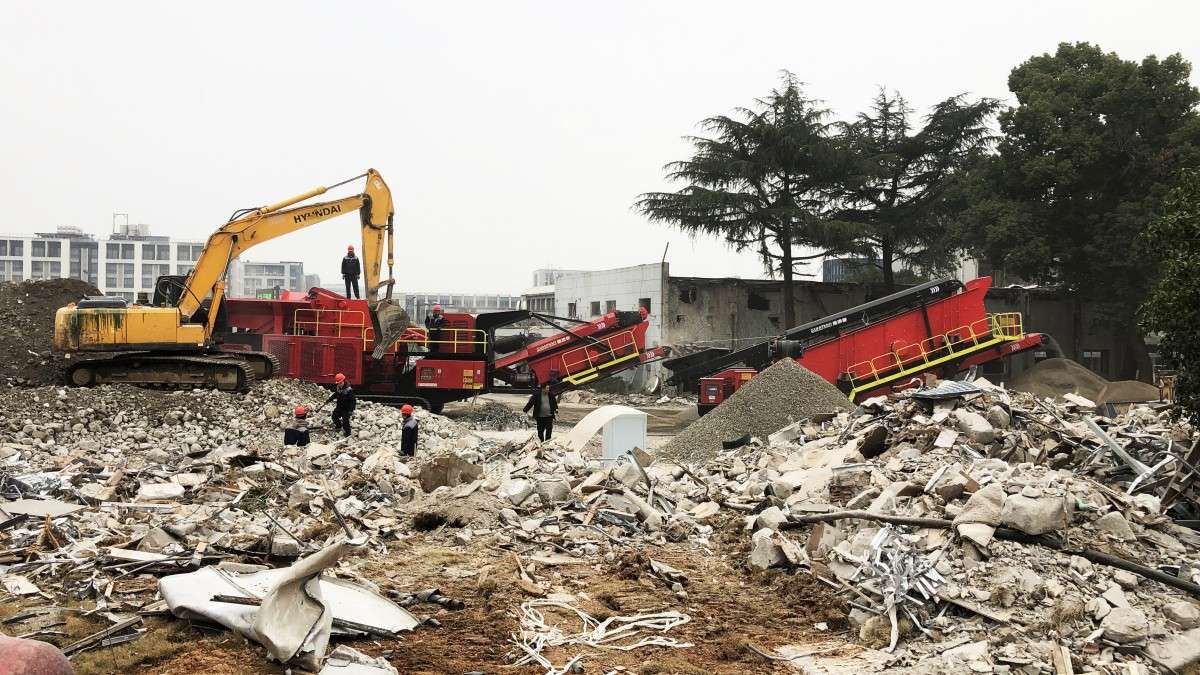
Diesel engines on mobile crushers are normally paired with one of two drive schemes. The first is hydrostatic: a diesel engine drives hydraulic pumps that feed the crusher, tracks, feeder and conveyors. Hydrostatic drive makes infinitely variable feeder and conveyor speed easy and provides strong torque at low speed for the jaw.
The second scheme is mechanical drive: the diesel engine drives the jaw crusher directly through a clutch or fluid coupling, with hydraulics used for auxiliary functions. Mechanical drive tends to transfer engine power more efficiently to the crusher, but it reduces flexibility of speed control. Neither scheme is unconditionally superior. Match the drive to site conditions: if you need to regularly change engine RPM to handle variations in feed grading or to tune the product, hydrostatic gives you better control. If you run one consistent material and want maximum crushing energy per litre of fuel, talk to the manufacturer about the mechanical versus hydraulic trade-off for the specific engine rating — fuel consumption figures are not published for this article and must be requested.
Also decide early whether you need a screen after the jaw. A full mobile crushing unit can work as a two-stage line: track-mounted jaw feeding a track-mounted cone or impactor with a screen. For concrete recycling, this can be jaw-to-screen with a magnet in between, closing the loop on oversize to send back to the jaw. Your chosen duty decides the number of stages, and the number of stages decides engine count and total fuel demand.
The table below replaces a specification sheet because a correct spec requires your site data. Use it as your submission checklist before asking any supplier for a model quote.
| Decision parameter | Why it matters | What you must provide / confirm |
|---|---|---|
| Feed type and hardness | Jaw suitability changes with granite, limestone, rubble or reinforced concrete | Rock type, abrasiveness, compressive strength if known, contamination level |
| Max feed size | Determines crusher inlet width and feeder design | Measured largest piece, not a guess; include a photo if possible |
| Moisture and clay content | High clay makes a jaw pack and stall | Percentage of fines and moisture observed at the site |
| Hourly output target | Sets crusher capacity, engine power, discharge conveyor size | Nominal tonnes per hour required after screening, plus peaks |
| Required product size | Determines closed-side setting and necessity of a screen or second crusher | Final grade specification, e.g. 0–20 mm, 20–40 mm, or 0–80 mm sub-base |
| Duty cycle and mobility | Day-long vs intermittent operation changes hp needs and fuel costs | Hours per day, days per month, material handling plan |
| Power availability on site | Diesel backup vs hybrid option | Distance to grid, allowable genset rating, refuelling location |
| Local emissions and noise rules | Can exclude continuous diesel or require a DPF and sound attenuation | Permit conditions, hours of operation limits |
Do not rely on generic throughput claims for these points. The machine output is influenced by the setting, the reduction ratio, the feeder settings, the moisture of feed and the wear condition of jaw plates. If you are told a particular tonnage figure without these matching site inputs, ask the SUHMAN technical team how they derived it and under what material assumptions.
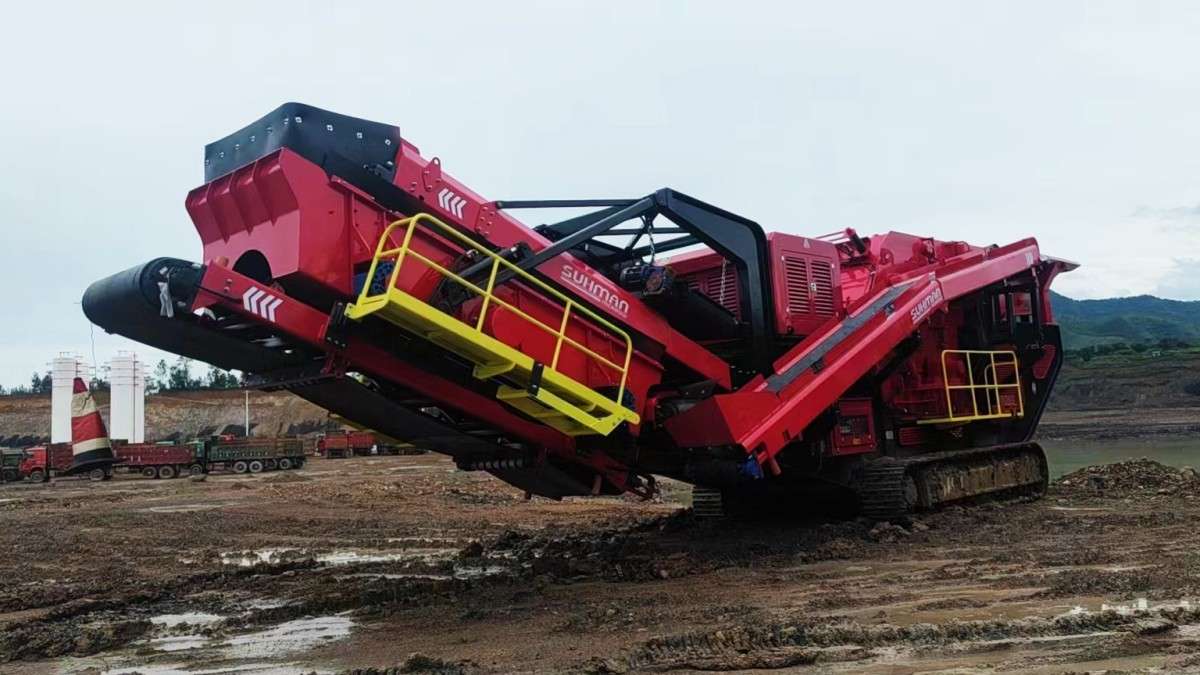
Start with feed size and required end product. It may sound basic, but the most common mistake is buying a jaw when the real bottleneck is downstream screening capacity, so the whole line needs reviewing as one system.
A practical formula to size the jaw at a preliminary level is the volumetric throughput equation: capacity roughly equates to the product of the crusher discharge opening cross-section and the material’s volumetric flow speed, then multiply by the bulk density and an adjustment factor for reduction ratio and feed distribution. Exact details belong to the manufacturer, but the lesson is that two sites with identical crushers can produce very different outputs because feed gradation differs. That is why a subjective «we want a 500-tonne-per-hour crusher» is not enough; the feed gradation curve and the product specification must accompany the tonnage request.
If your application is concrete recycling, the line order matters. A correct configuration can be: vibrating feeder with grizzly → jaw crusher → overband magnet → screen → return conveyor for oversize. If you are processing an aggregate stone crushing feed of natural rock, the configuration changes: feeder → jaw → cone/impact crusher → screen, then closed circuit if you need a controlled product. These configurations are a guideline; final selection needs equipment model and feed conditions.
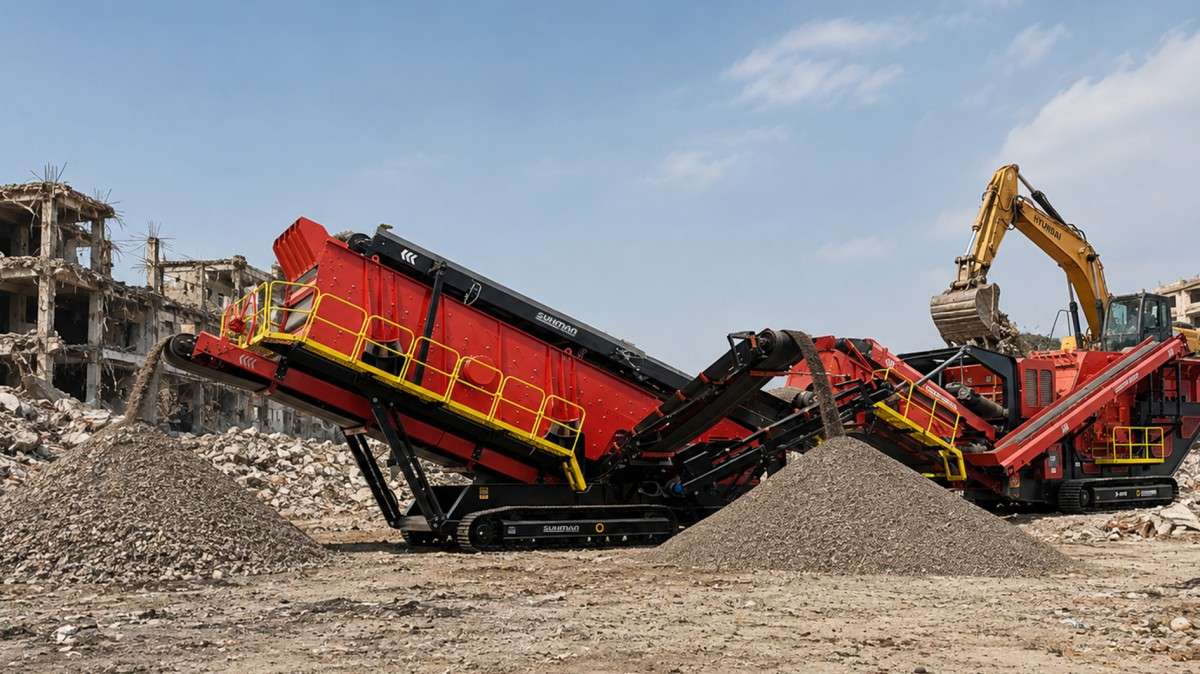
A diesel engine is the wrong option when the site is permanently connected to a reliable three-phase grid and the civil works to mount a fixed plant have already been budgeted. In that situation, an electric motor or hybrid drive avoids daily refuelling, exhaust treatment, and engine maintenance. It also reduces noise, which matters when the crushing yard sits close to residential areas or is operating under a strict environmental permit. If your long-term plan is to crush in the exact same location for more than a few years, ask the supplier for the expected service interval and refuelling implications of the diesel option; if your grid power is cheap and available, an electric plant is usually the more rational primary drive.
No, not in most specifications. A jaw crusher produces a coarse first-stage product with an elongated particle shape and an oversize fraction. For a typical road base or concrete aggregate specification, a secondary machine — cone crusher for hard abrasive rock or horizontal impact crusher for softer rock — is needed to generate cubical product within the target grading band. For concrete recycling, a jaw crusher alone can deliver a crushed subbase product if the specification’s particle shape requirement is generous. If you need recycled aggregate for controlled low-strength fill or for a specific client’s quality control, confirm particle size distribution with a screening deck before you promise it.
You need the feed specification, the product specification, and the operating context. That means rock type and hardness, moisture and contamination level, maximum feed size in millimetres, required output tonnes per hour, required product grading and the planned working hours per day. You should also confirm whether the machine will be hauled between sites and whether you will run a full remote site with refuelling logistics or stay within range of a local supplier. Without those inputs, no reputable supplier should commit to a capacity or a specific machine model.
The simplest protection is a vibrating feeder with a grizzly section that scalps fines and small metal before the jaw, followed by one overband magnet on the jaw discharge — and for reinforced concrete, preferably a second magnet or an eddy-current separator at the secondary stage. A rock catcher or metal detector can stop the belt before damaging steel enters the crusher. For concrete recycling, never feed rebar-heavy material directly without a magnet arrangement, because wire can wrap around the crusher shaft or block the discharge gap. The configuration that protects the machine is a feeder, jaw, magnet and screen arrangement rather than a single standalone jaw. The exact magnet strength and belt position should be spec’d by the crusher supplier based on your feed contamination estimate.
Support hours are Monday through Saturday, 9:00 AM to 6:00 PM Beijing Time, and you can contact the team by email, WhatsApp or mobile phone; inquiries made outside of business hours receive a response within 12 hours . Plan your maintenance questions and spare parts inquiries accordingly, and keep the serial numbers of your crusher and engine ready for the first call so that the support diagnosis can start without back-and-forth. For shutdowns that fall between Saturday evening and Monday morning, the 12-hour response commitment covers the gap, but remember that the physical repair action depends on spare parts delivery to your site, not just a remote answer. You can send a request directly through the contact page for calculations and browse the mobile crusher catalog before that call; for configuration considerations, the internal blog articles explain common conveyor and magnet layouts.