别走!
您尚未获得免费报价和确切价格。.
请留下联系方式,我们的工程师将为您项目量身定制解决方案。.
请留下联系方式,我们的工程师将为您项目量身定制解决方案。.

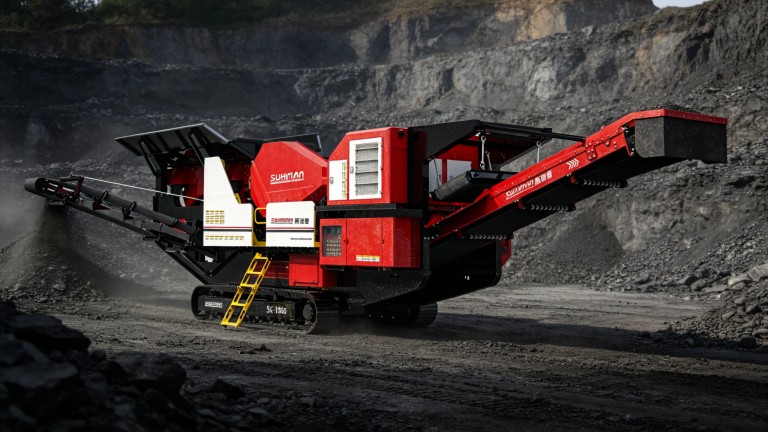
Learn the engineering principles, wet vs. dry dust control trade-offs, and the seven site-specific inputs you need before sizing a system for a crushing plant.
Dust control on a mobile crushing plant is not a single bolt-on device. It is a sequence of measures applied at each point where fine particles leave the process — the feed hopper, the crusher chamber, conveyor transfer chutes, the screen deck, and the final stockpile drop. In practice you choose between wet suppression (sprayed water), dry collection (baghouse or cyclone), or a staged combination of both. No verified SUHMAN product data is currently available for this topic, so this page gives engineering principles, a decision checklist, and the site-specific inputs you must confirm before any system can be sized.
Compression crushing does not merely split rock; it ejects a cloud of fine and respirable particles (the fraction below 10 µm) from the crusher cavity with every stroke. The visible plume you see over a quarry is mostly made up of particles that are too heavy to stay suspended, whereas the health-relevant dust is the fine fraction that drifts downwind. On a typical tracked plant, the largest escape points are:
Each of these points behaves differently, and a system designed for one will not necessarily work for another. A spray bar placed at the feed hopper does little for the screen deck if the transfer points are not covered.
Wet suppression is the lower capital-cost option and is the default in many quarries. Water is applied as fine spray at the generation points to wet the particle surface so that airborne dust sticks to coarser material instead of becoming suspended. The engineering estimate is that a well-arranged spray system can visibly reduce plume, but the actual capture efficiency depends on nozzle type, water pressure, droplet size, and contact time — none of which can be quoted generically.
The limits of wet suppression are real. Added moisture travels with the product and can blind screen decks when the material is clay-bound, it changes the moisture specification of the sold aggregate, and in cold climates the same water becomes ice on belts and chutes. If your product is sold on a moisture spec, or you operate through freezing winters, wet-only control may be unsuitable.
Dry collection uses hoods at each dust point, ducting, and a fan that pulls the dusty air to a baghouse or cyclone. The captured fines can be discharged back onto the product belt or into a waste bin, which means it does not change product moisture. The trade-off is capital cost, fan power, and the need for the material to stay dry enough that the filter bags do not clog. Dry collection is the wrong choice for sticky, high-clay feed, because the hoods and duct walls will coat and the system will progressively lose suction.
A common recommendation is to combine the two: dry collection on the crusher itself and the screen, with spray suppression on the feed hopper and stockpile, where dust is coarser and moisture impact is lower. That combination is an engineering recommendation, not a measured outcome, and the split must be justified with your measured dust concentrations, not assumed.
The table below is a buyer-input checklist. None of the values are filled in because they are site-specific; you or your vendor must confirm each row before a system can be quoted.
| Decision point | What to confirm on site | Why it changes the design |
|---|---|---|
| Material type and condition | Rock type, hardness, clay content, measured moisture at the crusher feed | Wet systems are limited by sticky fines; dry systems are limited by moisture blocking bags |
| Operating climate | Minimum winter temperature and whether water can freeze on belts | Freezing eliminates wet-only designs without heated water lines |
| Water availability | Flow rate and pressure available at the plant, plus water cost | Insufficient flow makes a spray system ineffective and must be confirmed, not assumed |
| Dust concentration targets | Local emission limit and the required respirable dust reduction | Both suppression and collection are sized against a target you must state |
| Product moisture spec | Maximum allowable moisture of the sold aggregate | Exceeding it disqualifies wet suppression regardless of price |
| Value of recovered fines | Whether collected dust can be blended into product or must be discarded | Dry collection can pay back when fines have market value |
| Space on the platform | Available deck area and weight allowance on the tracked chassis | Baghouses and fans occupy space that may not exist on a compact plant |
Any vendor who gives you a fixed airflow or water flow without asking for these seven items is quoting from a template, not from your conditions.
Wet suppression should not be your primary method if your crushing circuit operates below freezing and you have no heated water supply, because ice on the screen and return conveyor is a safety issue and a downtime cost. Dry collection should not be your primary method if your feed moisture is consistently high or the material contains plastic clays, because the filter medium will blind and the system will be maintenance-heavy. There is also a middle case: a plant producing only coarse construction aggregate in a warm climate with abundant water will almost always choose wet suppression; a plant producing fine aggregates for asphalt or concrete, where the product must remain dry, has effectively no choice but dry collection with a baghouse.
Before a dust control system can be sized, you must supply:
Without these inputs, any airflow or water pressure figure is a guess. If you do not have measured dust data, the correct first step is a short monitoring campaign, not a purchase.
Start at the points with the highest drop height and the highest particle velocity — the crusher inlet and the discharge onto the screen. These generate the bulk of the respirable fraction. The feed hopper creates visible dust but is coarse by comparison, so it can be addressed second. If you only have budget for one measure, put it on the transfer points between the crusher and the screen, where the air is thrown sideways with the falling material.
When the material is already near its optimum moisture for dust control, adding more water does not capture more dust — it simply raises product moisture. Water spraying also becomes counterproductive on a screen deck: wetted fines stick to the mesh and reduce screening efficiency, which drives recirculation load and can actually increase dust at the crusher because material is recycled. And in freezing temperatures, spray water on a belt is a fall hazard and an ice maintenance problem.
Suppression stops dust from becoming airborne by wetting the particle, so it stays with the material flow. Collection captures already-airborne dust by pulling it through a hood into a filter, then returns the clean air to the atmosphere and collects the dust separately. Suppression does not remove fine material from the process — it just keeps it in the product. Collection removes it, which changes the product gradation if the fines were part of the sellable spec. That distinction matters when you sell a premium fine aggregate.
Yes, and for many quarry circuits the combination is the most robust engineering solution. A dry collection hood is used at the crusher and screen where moisture must not enter the product, and spray suppression is used at the feed hopper and stockpile where dust is coarser and moisture is less harmful. The constraint is space: a baghouse and fan need deck area, a compressor, and electrical power that a compact tracked plant may not have. The combination must be designed for the available platform, which is why the layout input is essential before quoting.
You need four measured or stated items: the dust concentration at each point, the material moisture and clay content, the available water flow or electrical power, and the required emission limit. Without these, the vendor can only offer a generic system. Ask the vendor to state their assumed capture velocity and airflow per hood, and to show the calculation — an engineering estimate is acceptable, but it must be explicit about its assumptions.